Silsesquioxane-based hybrid materials offer a useful middle ground between discrete organosilicon molecules and conventional inorganic fillers. Their silicon–oxygen-rich framework can be built as compact polyhedral oligomers, open-cage silanol intermediates or oligomeric/polysilsesquioxane T-resins, while organic groups attached to silicon provide compatibility or reactivity with polymer, coating and composite systems.
At Eata Silicon, material selection starts with what the formulation needs to do: copolymerize with an acrylic resin, react into an epoxy network, improve interface control, form a robust coating, support dielectric design, or provide a silicon-rich precursor for advanced material development. We help customers compare candidates by architecture, functional group, physical form and specification rather than relying on a single trade name.
 Fig. 1. Conceptual view of silsesquioxane-rich domains carrying outward-facing organic functionality for hybrid material design.
Why Silsesquioxane Architecture Gives Formulators More Options
Polysilsesquioxanes are commonly described by the empirical RSiO1.5 composition. In practice, that simple formula covers a broad structural family: amorphous or oligomeric T-resins, well-defined T8 cages, open T7 silanol structures and functionalized cage mixtures. The organic group R is not just a pendant decoration—it is one of the main levers used to control how the silicon-rich structure enters a resin, reacts during cure, disperses in a formulation or interacts with an interface.
That is why the same material class appears in very different formulation strategies. A vinyl- or methacrylate-functional cage can enter radical or addition chemistry; glycidyl functionality can participate in epoxy networks; amino or silanol groups create other reactive pathways; phenyl and alkyl substitution can shift compatibility and physical behavior; and T-resins can act as film-forming or network-forming silicon-rich binders. The useful question is not simply "Which POSS should I buy?" but "Which architecture and functionality fit my matrix and process?"
- Molecular-scale hybridization — silicon–oxygen-rich structure and organic functionality are combined within the same material platform.
- Multiple incorporation routes — candidates can be copolymerized, crosslinked, condensed, blended, surface-associated or used as resin components depending on chemistry.
- Different physical formats — market examples include powders, viscous liquids, resinous solids and solution-based T-resin products.
- Specification-led selection — functional-group content, water, residuals, viscosity, solids, molecular range and compatibility can matter as much as the nominal chemical name.
 Fig. 2. T-resin processability concept representing a low-molecular or oligomeric silsesquioxane phase before it is incorporated into a coating or resin system.
Four Practical Material Routes
1. Reactive POSS Monomers for Polymer Incorporation
Functional T8-type cages are attractive when the silsesquioxane unit is intended to become part of the organic network rather than remain only as a dispersed additive. Vinyl, methacrylate and acrylate functionality can provide polymerizable handles, while selected hydride-bearing structures can participate in silicon-based addition chemistry. The final result depends strongly on loading, cure route, compatibility and how uniformly the cage is incorporated.
2. Epoxy-, Amino- and Silanol-Functional Silsesquioxanes
Glycidyl/epoxy, amino and silanol functionality gives formulators additional routes for coupling a silsesquioxane core to an epoxy resin, polyurethane-related system, oxide-rich surface or condensation network. These products are especially useful to evaluate when the interphase—not only the bulk resin—controls adhesion, dispersion, moisture response or electrical performance.
3. Polysilsesquioxane T-Resins
T-resins are broader, more resin-like structures than discrete POSS cages. Commercial literature includes methyl-, phenyl-, propyl-, octyl- and methacryloxypropyl-containing polysilsesquioxanes in liquid, solid and solution forms. They are used in coating-resin design, primer systems, organic-resin modification, microelectronic layers and silicon-rich films. Their cure and film behavior should be matched to the formulation rather than inferred from the generic T-resin label.
4. Phenyl and Other Structurally Tuned Cages
Not every silsesquioxane needs to be highly reactive. Phenyl-substituted cages and resin architectures are used as model structures or modifiers in thermal, optical, dielectric and polymer research. When low reactivity is intentional, solubility, dispersion, phase behavior and the surrounding polymer become the main selection variables.
 Fig. 3. Thin-film concept showing a transparent hybrid layer conforming to a microstructured substrate without relying on a conventional particulate coating picture.
Representative Silsesquioxane Materials
| Representative Materials |
CAS No. |
Functional Architecture |
Keywords |
| Poly(vinylsilsesquioxane), T8 / octavinylsilsesquioxane |
69655-76-1 |
Fully vinyl-functional T8 cage |
octavinyl POSS; vinyl POSS; reactive silsesquioxane |
| Methacryloxypropyl-substituted poly(isobutylsilsesquioxane) |
307531-94-8 |
Single methacrylate-functional T8 |
methacryl isobutyl POSS; polymerizable POSS |
| Silanol-functional poly(isobutylsilsesquioxane) |
307531-92-6 |
Open T7 / trisilanol structure |
trisilanol isobutyl POSS; silanol POSS |
| AminopropylIsobutyl POSS |
444315-15-5 |
Amino-functional cage with isobutyl groups |
amino POSS; aminopropyl POSS; resin modifier |
| Glycidyl POSS cage mixture |
68611-45-0 |
Glycidyl / epoxy-functional cage mixture |
glycidyl POSS; epoxy POSS; reactive POSS diluent |
| Octaphenylsilsesquioxane |
5256-79-1 |
Phenyl-substituted T8 cage |
octaphenyl POSS; phenyl silsesquioxane |
| Poly(methylsilsesquioxane), liquid T-resin |
181186-37-8 |
Methoxy-terminated oligomeric T-resin |
methyl T-resin; polysilsesquioxane coating resin |
| Poly(methylsilsesquioxane), solid T-resin |
68554-70-1 |
Methyl polysilsesquioxane resin |
solid methyl T-resin; hybrid silicon binder |
| Poly(phenylsilsesquioxane) |
70131-69-0 |
Phenyl polysilsesquioxane T-resin |
phenyl T-resin; phenyl polysilsesquioxane |
| Poly(methacryloxypropylsilsesquioxane) |
160185-24-0 |
Methacrylate-functional polysilsesquioxane |
methacrylate polysilsesquioxane; UV-curable hybrid resin |
| Poly(hydridosilsesquioxane) |
137125-44-1 |
Hydride-substituted polymeric T8-type material |
hydrogen silsesquioxane; HSQ; silicon-rich film precursor |
How to Select a Silsesquioxane-Based Hybrid Material
| Decision Point |
What to Define |
Why It Matters |
| Architecture |
Discrete T8 cage, open T7 silanol, cage mixture, oligomeric T-resin, polymeric polysilsesquioxane |
Changes molecularity, reactivity, viscosity, dispersion behavior and how the material enters the network. |
| Organic functionality |
Vinyl, methacrylate/acrylate, glycidyl/epoxy, amino, phenyl, alkyl, hydride, silanol |
Defines polymerization, coupling, condensation, hydrosilylation-related or compatibility pathways. |
| Matrix / substrate |
Epoxy, acrylic, silicone, polyurethane-related system, polyolefin, metal oxide, silica, ceramic, carbon-rich filler |
The same silsesquioxane can behave very differently in different chemical environments. |
| Physical form |
Powder, solid resin, viscous liquid, solution or pre-dispersed format |
Determines dosing, mixing, solvent choice, film formation and processing practicality. |
| Process route |
Thermal cure, radical/UV cure, addition cure, condensation, solution coating, melt or compounding route |
Narrows the functional groups and physical formats that are realistic for the process window. |
| Target performance |
Dielectric response, interface control, barrier, thermal stability, hardness, flexibility, dispersion or film formation |
Keeps the selection focused on the property that drives the project. |
| Analytical controls |
Assay/composition, water, residual solvent or monomer, viscosity, solids, functional-group level, critical impurities |
Supports reproducibility when the chemistry is moisture-sensitive or highly reactive. |
Where Silsesquioxane Hybrids Fit in Energy and Advanced Manufacturing
In energy-material development, silsesquioxanes are usually most valuable where performance is controlled by a polymer-rich phase, a thin film or an interface. Published work spans electrical insulation, dielectric polymers, solid polymer electrolytes, lithium-metal interphases, corrosion-protective coatings and microelectronic layers. These are formulation-dependent research directions rather than universal properties of every POSS or T-resin.
Electrical Insulation and Dielectric Polymer Systems
POSS-modified epoxy systems have been studied for dielectric loss, breakdown behavior and performance after thermal aging. The effect depends on the functional group, loading level, network structure and dispersion state, so the relevant raw material should be selected together with the base epoxy and cure chemistry rather than as a generic dielectric additive.
 Fig. 4. Electrical-insulation concept using a polymer-rich matrix with controlled silsesquioxane modifier zones around embedded conductors.
Battery Electrolyte and Interphase Research
Silsesquioxane-containing ionic liquids and polymeric ionic-liquid architectures have been reported in solid polymer electrolyte research, while newer work has explored POSS-containing artificial interphases for lithium metal. For sourcing, that points to a chemistry-first discussion: ionic functionality, polymerizable group, compatibility with the host polymer, residual moisture and the exact electrochemical role are all more meaningful than requesting "battery-grade POSS" as a single generic category.
 Fig. 5. Porous separator research concept with a uniform hybrid surface treatment shown along the exposed membrane face.
Protective Coatings and Barrier Layers
Reactive silsesquioxanes can be evaluated in epoxy, acrylic, silicone and other coating systems when the formulation requires a denser network, modified surface interaction or a more robust polymer–inorganic interface. Recent coating research continues to investigate POSS-derived structures in corrosion-protection and high-temperature primer concepts. The most useful RFQ includes the substrate, binder, cure route, film thickness target and the barrier or adhesion property being optimized.
Microelectronics, Patterned Dielectrics and Silicon-Rich Films
Polysilsesquioxane chemistry also has a long history in dielectric, planarization and reactive-ion-etch-resistant layers. Hydride-rich silsesquioxane materials are used as silicon-rich film precursors, while other T-resins and functional cages can be evaluated in patterned or optoelectronic material development. Solvent system, solids, film thickness, cure temperature and residue control are key specification variables in these applications.
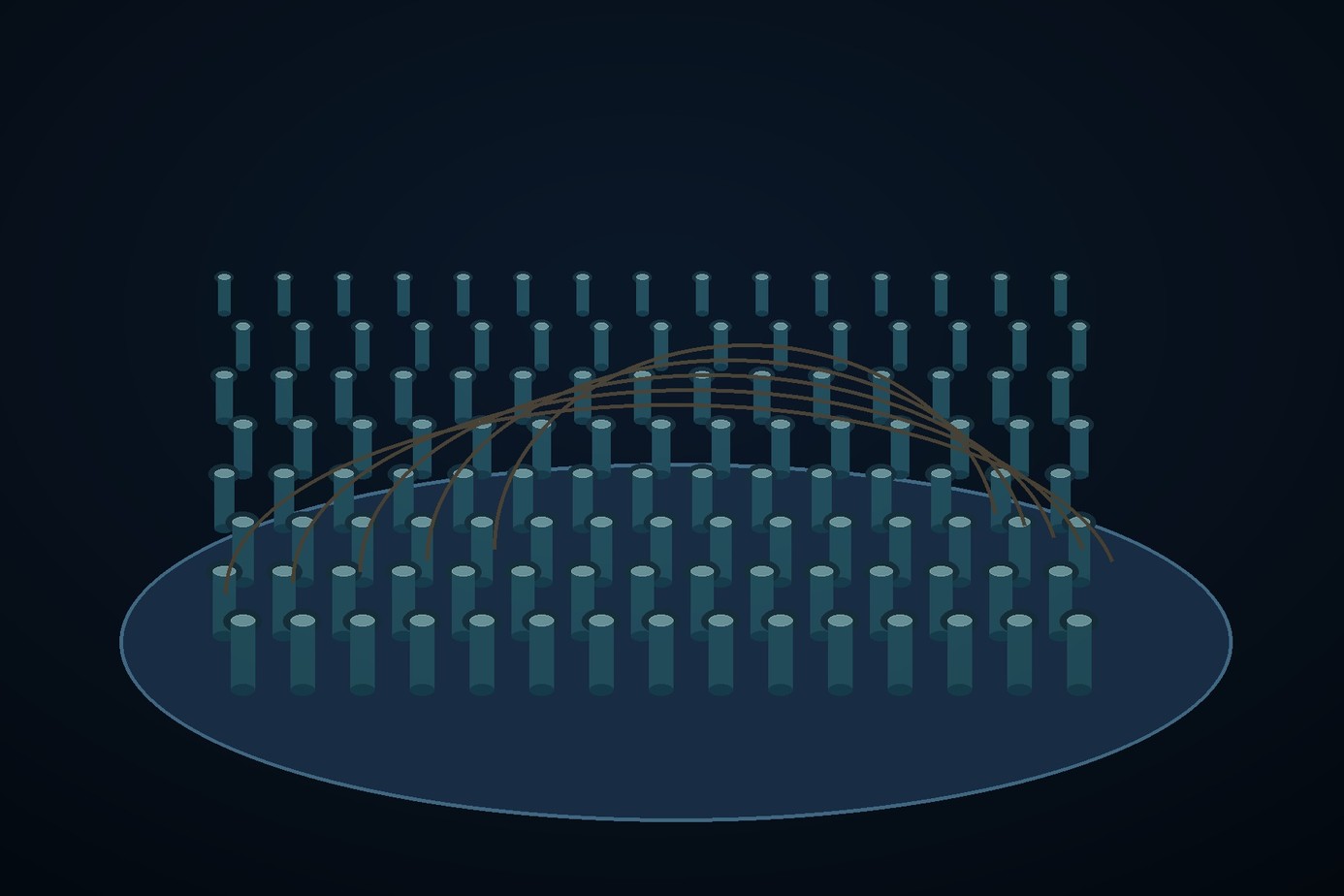 Fig. 6. Micro-patterned dielectric-film concept illustrating how silicon-rich hybrid chemistry can be considered in precision coating and electronic-material development.
When an off-the-shelf material does not fit the required process window, Eata Silicon can review customized silsesquioxane-based requests. Depending on technical feasibility, customization can focus on organic functionality, degree of substitution, cage or T-resin architecture, solids or solvent system, molecular or viscosity range, assay/composition, water and residual controls, selected impurity limits, physical form and packaging.
For a focused technical discussion, send the target structure or closest reference material, the matrix or substrate, the reaction or formulation route, the specifications that are critical to your process and the performance target used to evaluate success. We can then assess a standard option, a close functional analogue or a customized material pathway for the project.
Discuss your Silsesquioxane-Based Hybrid Materials requirement with Eata Silicon — share the chemistry, interface and specification that matter to your formulation.
For Research or Industrial Raw Materials, Not For Personal Medical Use!