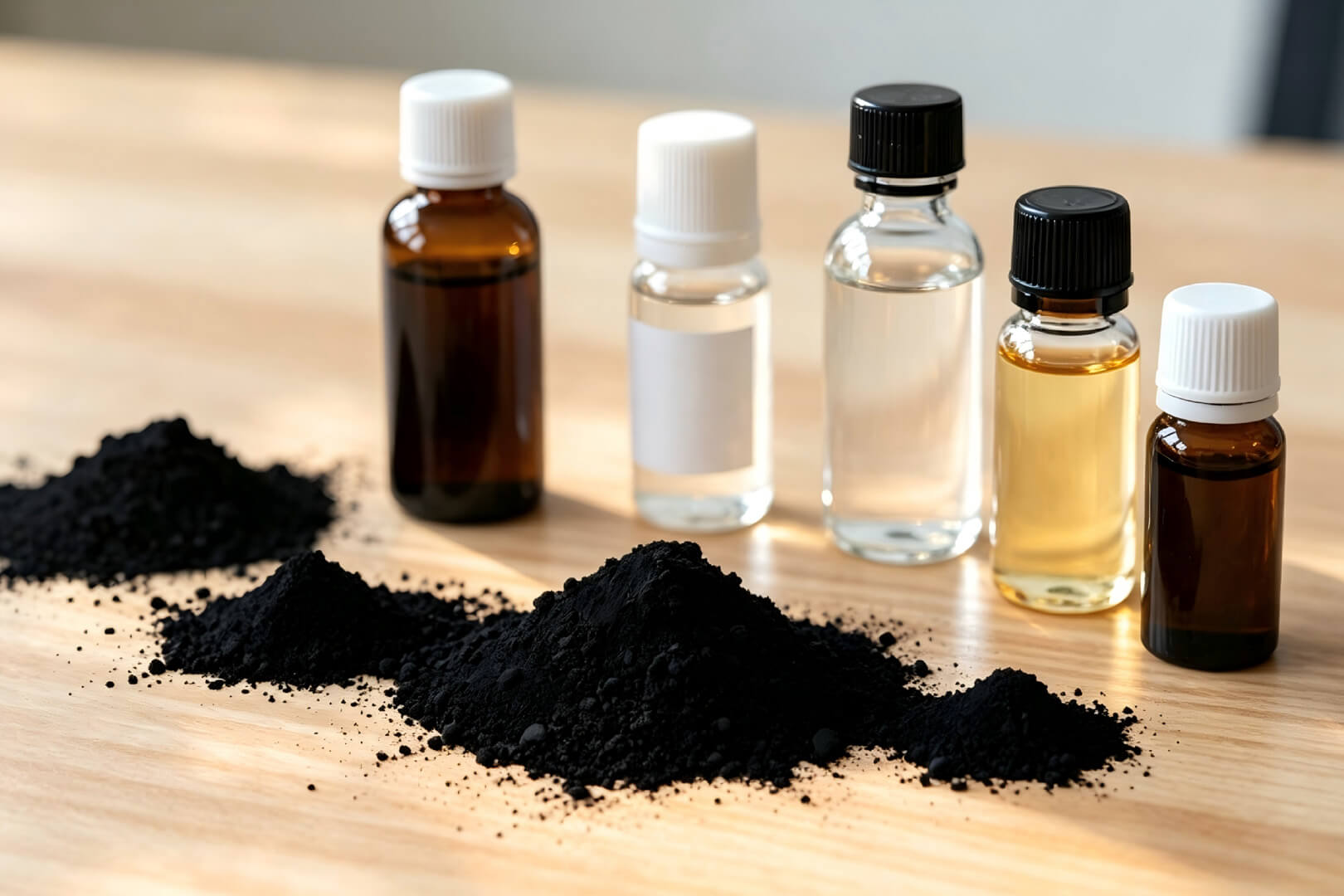
In 1891, Edward Goodrich Acheson was trying to grow artificial diamond in an electric furnace. What crystallized around his graphite electrode instead was something nobody had made on purpose before: a glittering compound of silicon and carbon that he named carborundum, believing it to be carbon fused with corundum. The mistake turned out to be worth more than the goal – Acheson's 1893 patent on the material was later counted by the U.S. Patent Office among the twenty-two patents most responsible for the industrial age. More than 130 years later, the world still produces over 800,000 tonnes of silicon carbide a year, essentially by the process he stumbled into.
Natural silicon carbide – the mineral moissanite, first identified in a meteorite in 1905 – is so rare that virtually every grain in commerce is synthetic. What keeps demand growing is a rare double identity: at Mohs 9–9.5 it is one of the hardest substances manufactured at scale, the backbone of the abrasives and refractories industries; and as a wide-bandgap semiconductor it is reshaping power electronics from electric vehicles to solar inverters. Eata Silicon supplies silicon carbide raw materials across this entire spectrum – abrasive grits, metallurgical and refractory grades, high-purity powders, and electronic-grade material – with custom sizing and chemistry available on request.
Browse Our Products
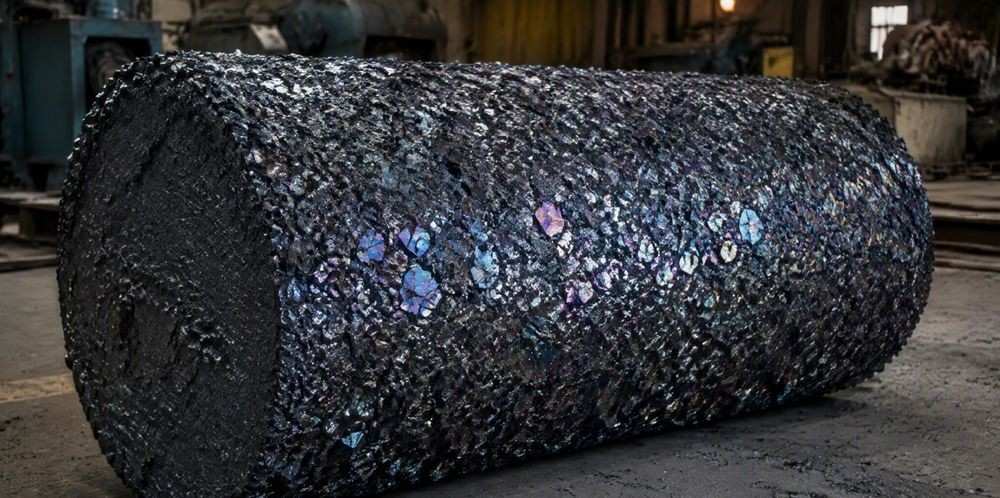 Fresh from the Acheson furnace: a crude SiC ingot awaiting crushing and grading.
From Sand and Coke to Carborundum: How SiC Is Made
Silicon carbide does not melt – it decomposes near 2,730 °C – so it cannot be cast like a metal. Every commercial form starts as a reaction between a silicon source and a carbon source, and the route chosen fixes the purity, crystal phase, and price:
- The Acheson process – a resistance furnace charges high-purity quartz sand and petroleum coke around a graphite core; passing current through the core drives the reaction SiO₂ + 3C → SiC + 2CO at core temperatures of roughly 1,700–2,500 °C over one to two days of firing. The product grows as a cylindrical ingot in radial layers: coarse α-SiC nearest the core, then β-SiC, then metallurgical-grade material, with unreacted mix recycled from the outside.
- Green versus black – both come from the same furnace; the difference is raw-material purity. Green SiC exceeds 99% SiC and is the harder, sharper abrasive; black SiC runs about 98% with free silicon and carbon, and offers the better economics for general grinding, blasting, and refractory use.
- Low-temperature carbothermal reduction – reacting fine, reactive silica and carbon powders at 1,500–1,800 °C yields fine β-SiC powder directly, avoiding the heavy milling that coarse Acheson crude requires.
- Direct silicon–carbon reaction – reacting pre-purified silicon metal powder with carbon at 1,000–1,400 °C sidesteps the impurities carried in by sand and coke, producing the high-purity β-SiC demanded by electronics and advanced ceramics.
- Crystal growth and densification – sublimation methods (the modified Lely process, now physical vapor transport) grow single-crystal boules for wafers, while sintering above 2,200 °C or reaction bonding turns SiC powders into dense seals, nozzles, kiln furniture, and armor.
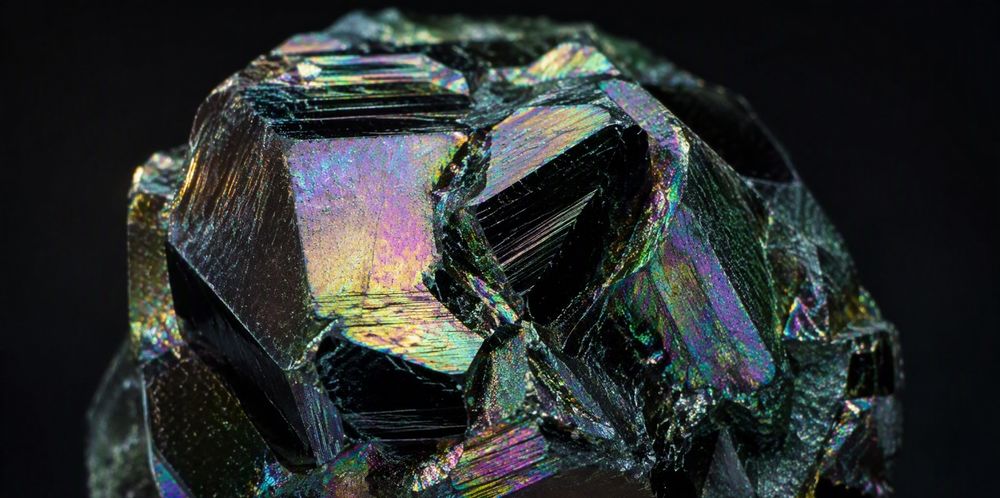 Iridescence on a SiC crystal – the fingerprint of its thin silica skin.
The Numbers Behind the Reputation
Silicon carbide's specifications read like a wish list for extreme service. The figures below explain why it keeps displacing other ceramics, metals, and even silicon itself:
| Property |
Typical Value |
| Hardness |
Mohs 9–9.5 (Knoop 2,480–2,550); surpassed only by diamond, boron carbide, and cubic boron nitride |
| Density |
3.21 g/cm³ – close to aluminum, far below steel or tungsten carbide |
| High-temperature behavior |
No melting point; sublimes/decomposes near 2,730 °C; serves to ~1,500–1,600 °C in air behind a self-forming SiO₂ film |
| Thermal conductivity |
120–490 W/m·K depending on polytype and purity – up to three times that of silicon, and above copper |
| Thermal expansion |
4.0–4.5 × 10⁻⁶ K⁻¹ – the low CTE behind its exceptional thermal-shock resistance |
| Bandgap |
2.36 eV (3C), ~3.0 eV (6H), ~3.26 eV (4H) – versus 1.1 eV for silicon |
| Breakdown field |
2–3 MV/cm, roughly ten times silicon's ~0.3 MV/cm |
| Electron saturation velocity |
~2 × 10⁷ cm/s, twice that of silicon – the key to high-frequency power devices |
One Material, More Than 250 Polytypes
Stack the same Si–C bilayers in different sequences and you get different crystals: more than 250 polytypes of SiC are known. Three dominate commerce. Cubic 3C-SiC (β-SiC) forms at lower temperatures and arrives as fine powders for polishing, sintering, and composite reinforcement. Hexagonal 6H-SiC, the most abundant Acheson product, carries a ~3.0 eV bandgap and historically served optoelectronics and substrates. Hexagonal 4H-SiC is the power-electronics polytype: a ~3.26 eV bandgap, electron mobility of 800–1,000 cm²/V·s (about double 6H's ~400), and the thermal conductivity to pull heat out of dense devices. Semi-insulating SiC above 10⁵ Ω·cm, meanwhile, anchors RF and microwave devices – and SiC's ~3.5% lattice mismatch with GaN makes it the substrate of choice beneath GaN LEDs and HEMTs.
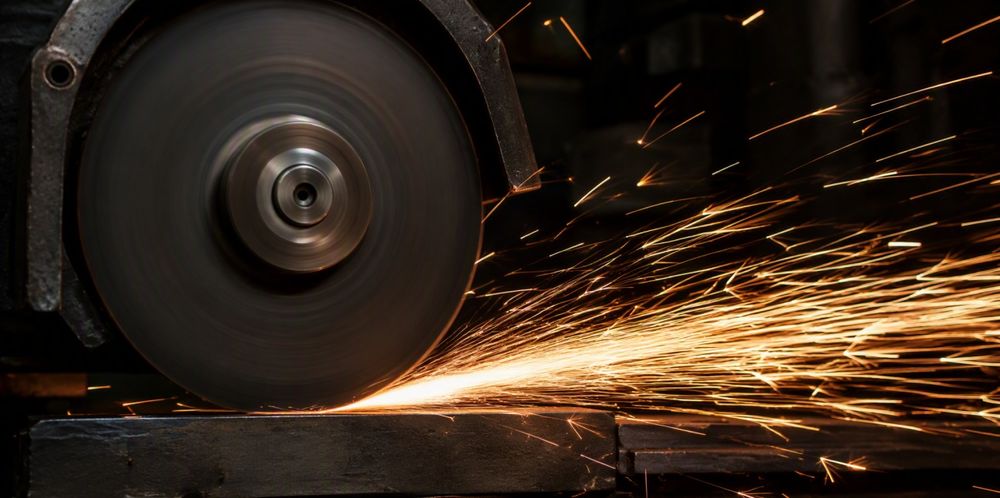 Sparks fly: bonded and coated abrasives remain SiC's largest market.
Where Silicon Carbide Earns Its Keep
- Abrasives and machining – grinding wheels, sandpaper, blasting media, wire-saw slurry, and lapping compounds in FEPA sizes from F8 macrogrit down to F1200 microgrit; at 1,000 °C SiC remains about 7.5 times stronger than alumina.
- Refractories and kiln furniture – setter plates, beams, saggers, and burner nozzles that carry full loads at firing temperature for years, thanks to the combination of hot strength, thermal conductivity, and shock resistance.
- Metallurgy – metallurgical-grade SiC (~90%) works as a deoxidizer and silicon–carbon additive in iron and steel melts, dissolving cleanly at tapping temperatures.
- Heating elements – resistive SiC glow bars heat furnaces to around 1,600 °C in air, outlasting metallic elements by a wide margin.
- Power electronics – SiC MOSFET inverters reached the road in 2018 with the Tesla Model 3; the resulting drive unit posts about 97% efficiency in a 4.8 kg inverter, under half the weight of comparable silicon-IGBT units – more range from the same battery.
- Wear and structural parts – mechanical seal faces, pump components, blast nozzles, and armor systems that exploit hardness plus chemical inertness in acids, alkalis, and molten salts.
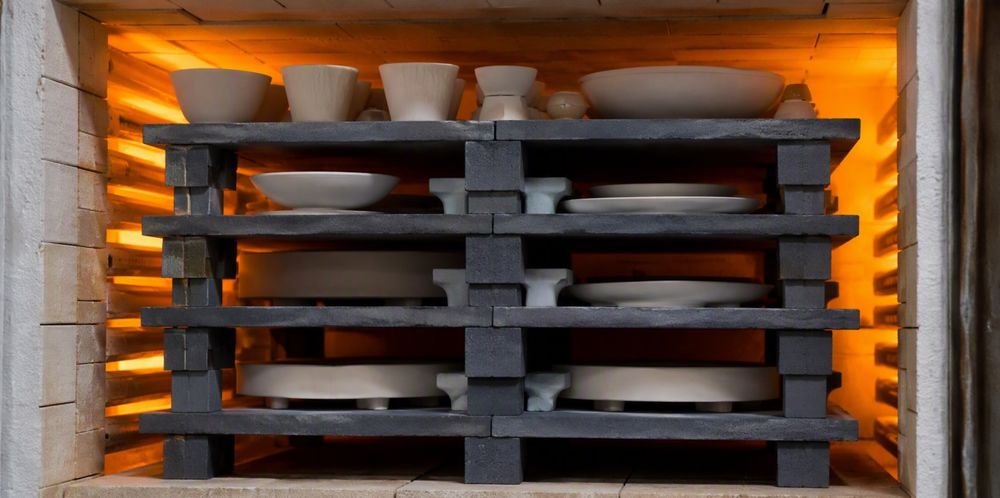 Kiln furniture that outlasts the kiln around it.
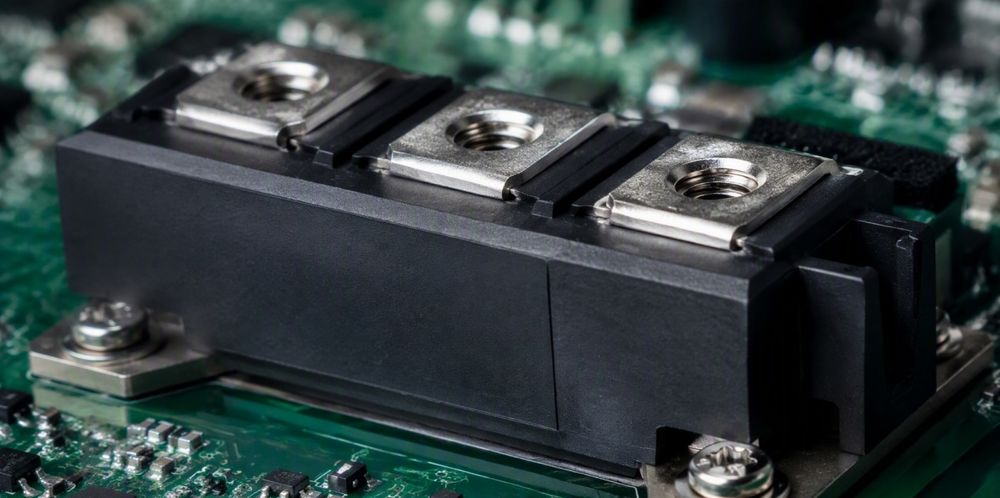 The wide-bandgap heart of a modern power converter.
Representative Products at a Glance
| Product Type |
Typical Specification |
Typical Use |
| Black silicon carbide macrogrit |
~98% SiC, F8–F220 (FEPA/ANSI) |
Bonded abrasives, blasting, cutting |
| Green silicon carbide microgrit |
>99% SiC, F230–F1200 |
Precision lapping, polishing, honing |
| Green SiC coated-abrasive grain |
P12–P3000 (FEPA P-series) |
Sandpaper, belts, discs |
| High-purity SiC powder |
3N–4N (99.9–99.99%), controlled PSD |
Electronics, advanced ceramics, R&D |
| β-SiC (beta) powder |
Submicron to nano, cubic phase |
Sintering, composites, catalyst supports |
| Metallurgical-grade SiC |
~90% SiC, sized lumps and grains |
Steel and iron deoxidation, Si/C additive |
| Refractory-grade SiC |
Grains and fines, high hot strength |
Kiln furniture, linings, castables |
| Sinterable α-SiC powder |
Submicron, sintering-aid ready |
SSiC seals, nozzles, structural parts |
| Electronic-grade SiC |
Low metals, for crystal growth and epitaxy |
Substrates, PVT source material |
| SiC whiskers and platelets |
High aspect ratio crystals |
Composite reinforcement, toughening |
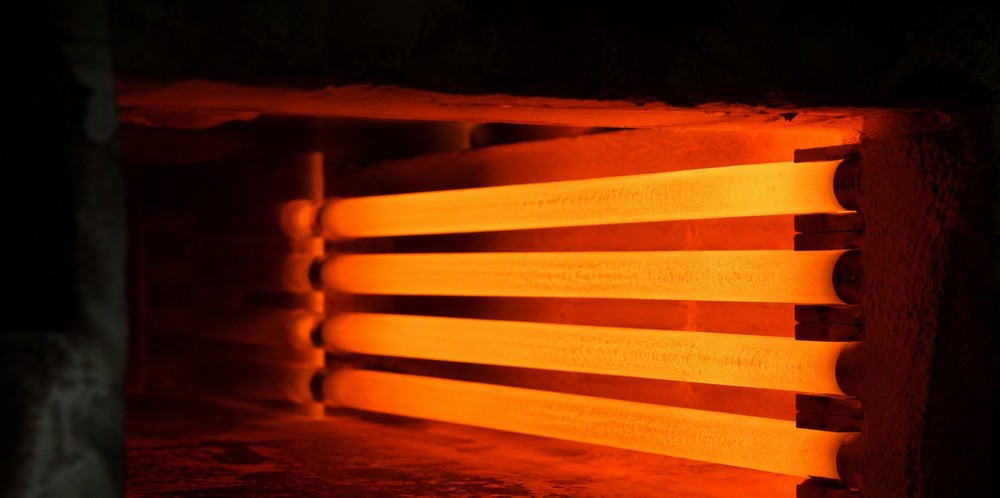 Straight-rod SiC glow bars holding furnace temperature, cycle after cycle.
Custom Silicon Carbide Services
Standard FEPA sizes cover most benches and furnaces, but plenty of projects sit between the catalog lines. Eata Silicon regularly supplies custom particle size distributions cut to a target D50, blended grit packages matched to a proprietary wheel or slurry formulation, tightened chemistry windows for electronic and ceramic applications, surface-treated and pre-dispersed powders, and pilot lots scaled for process development before production commitment.
Send us your target size, chemistry, and application, and our team will respond with a recommended grade, a specification sheet, and samples for your own evaluation.
For Research or Industrial Raw Materials, Not For Personal Medical Use!