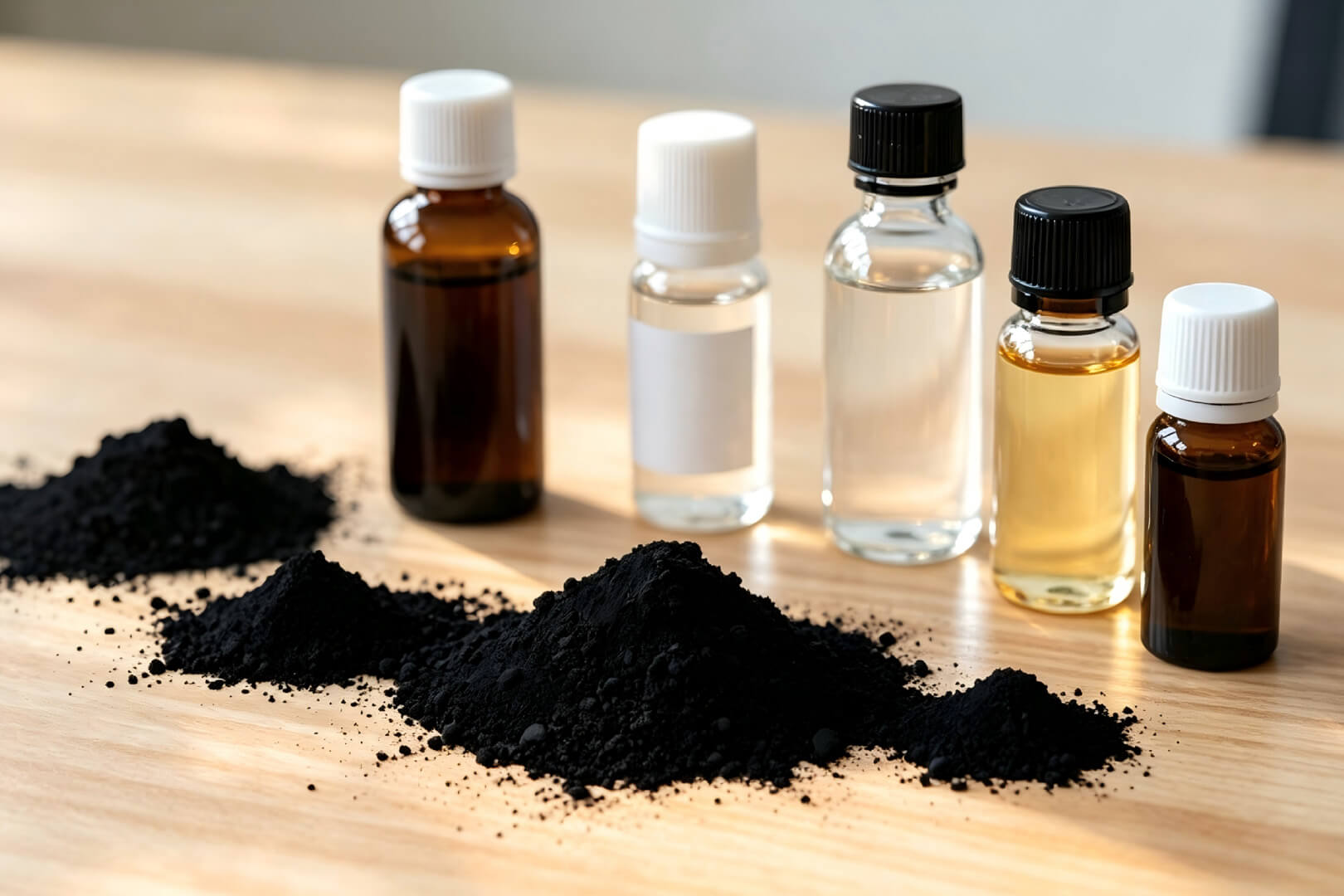
Silicon dioxide is the most abundant compound in the earth's crust — and one of the most deliberately engineered. The same SiO₂ formula arrives as angular milled quartz, as glass-smooth fused silica, as spheres rounder than ball bearings, and as dispersions so fine they never settle. Each form does a different job, and choosing wrongly is expensive: a semiconductor package filled with the wrong grade cracks in thermal cycling, while the right one carries 60–90% silica by weight and protects the chip for decades.
Eata Silicon supplies the three product families on this page — silica powders across every production route, spherical silica microspheres for electronics and research, and certified silica reference standards for instrument calibration.
Browse Our Products
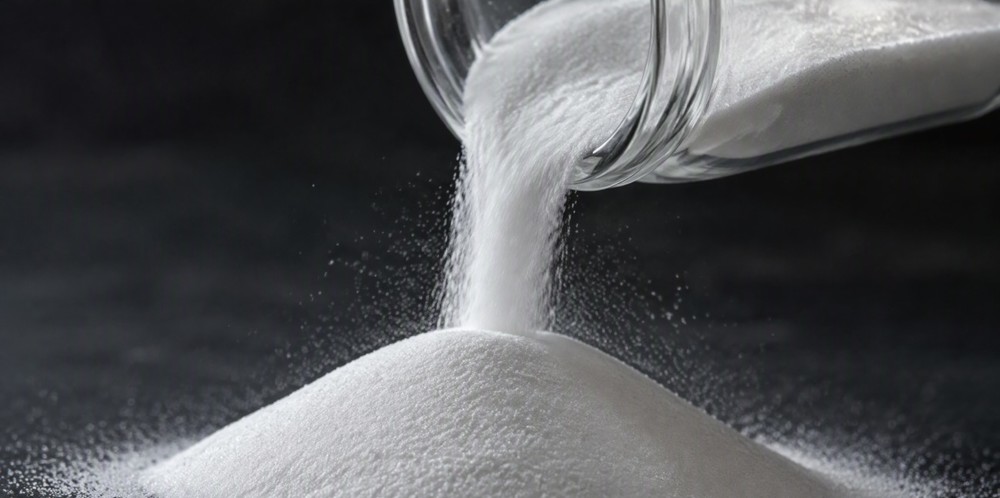 High-purity silica powder — the base of the range.
Same Formula, Different Materials
Two questions separate every silica grade from every other: is it crystalline or amorphous, and how was it made? Milled quartz keeps the crystal structure of the original sand — hard, angular, economical. Fused silica starts as quartz but is melted above 1,800 °C and quenched into a glass, trading crystallinity for a thermal expansion coefficient near 0.5 × 10⁻⁶/K. The synthetic amorphous family goes further, and industry recognizes four members:
- Fumed silica (CAS 112945-52-5): flame-hydrolyzed, non-porous, with enormous surface area — the strongest thickener and thixotrope of the group.
- Precipitated silica (CAS 112926-00-8): wet-process and porous, the workhorse reinforcing filler of modern rubber.
- Silica gel: the rigid, highly porous form behind desiccants and matting agents.
- Colloidal silica: a stable sol of discrete nanoparticles in water, used as binder, densifier, and polishing medium.
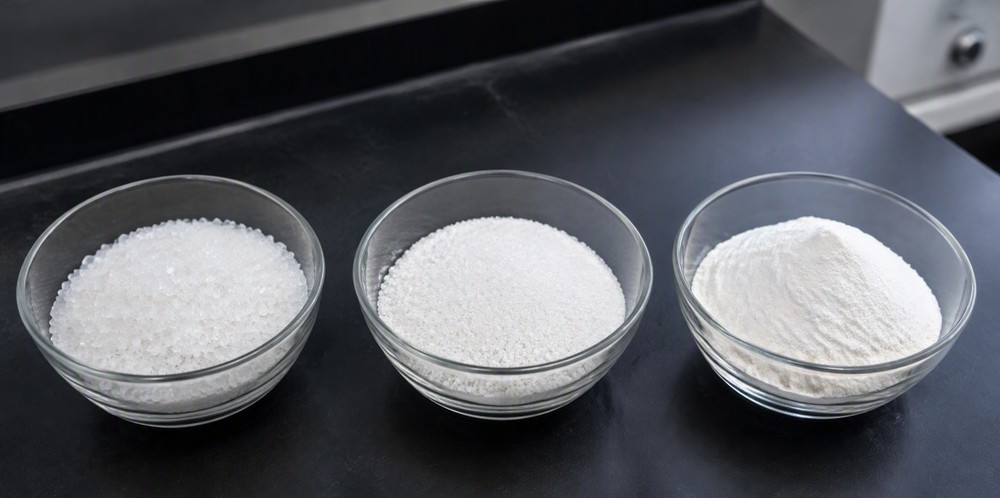 Three particle-size grades, one chemistry.
- Quartz silica powder: crystalline, milled and classified from 100 mesh to micron cuts — the economical filler for casting, glass, coatings, and construction chemistry.
- Fused silica powder: amorphous and ultra-low in expansion; the shell material of investment casting and the base grade for electronic fillers.
- Precipitated silica: at 150–200 m²/g BET, paired with silane coupling agents, it is the filler that gave "green tires" their rolling-resistance and wet-grip gains.
- Fumed silica: a pinch transforms rheology — anti-sag in coatings, anti-settling for pigments, thixotropy in adhesives and sealants, reinforcement in silicone rubber.
- Colloidal silica sols: 7–100 nm particles at 10–50% solids, binding investment-casting shells, densifying concrete, and polishing wafers in CMP slurries.
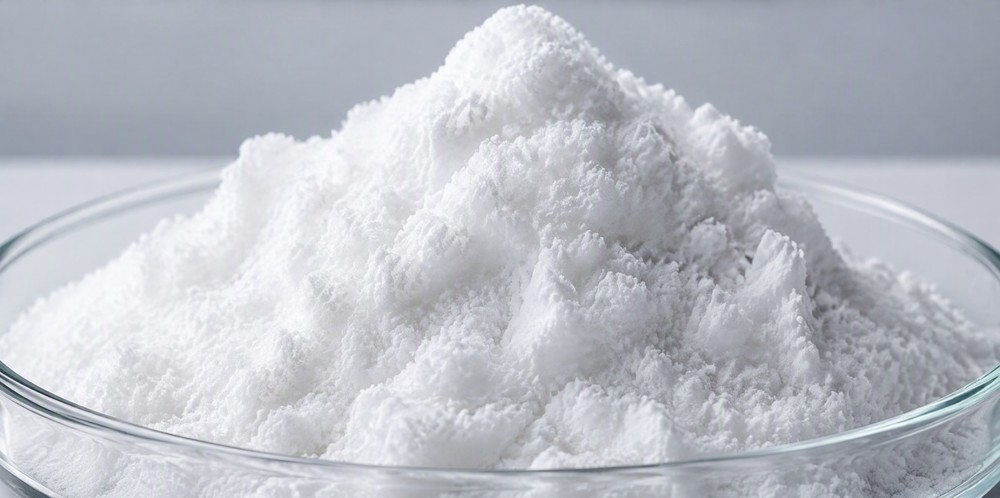 Fumed silica: light as smoke, strong as a thickener.
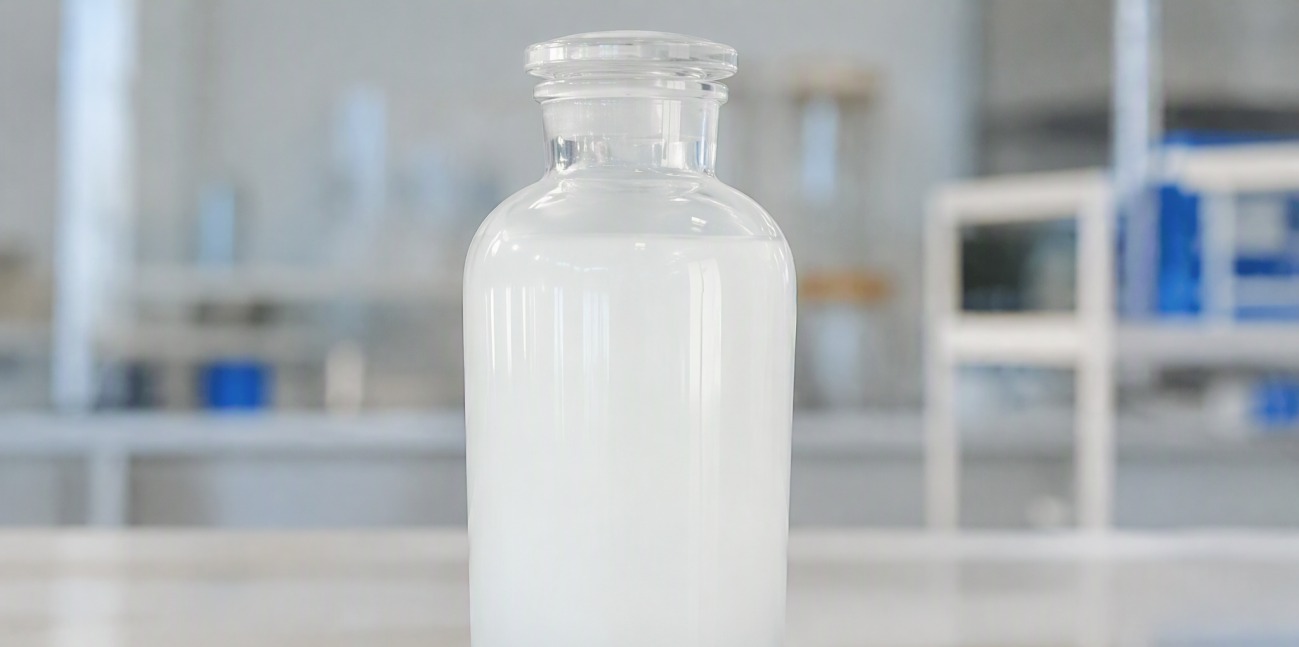 Colloidal silica sols for polishing and binding.
Pass fused silica through a flame hot enough to melt each particle and surface tension does the rest — every grain pulls itself into a sphere. The result, typically 99.9–99.99% SiO₂ with sphericity above 95%, behaves like a different material in a resin: spheres roll past each other instead of locking, so an epoxy molding compound accepts 88–92% filler by weight and still flows into mold gates a hundred micrometers wide. With a tuned distribution between 0.1 and 30 µm, packing density can exceed 92% and epoxy consumption can fall by up to half.
The physics matters downstream. Spherical silica's expansion coefficient of 0.5–0.7 ppm/°C sits close to a silicon die's 2.5 ppm/°C, so packages survive reflow and thermal cycling without warping or delaminating. Low-alpha grades emitting ≤0.001 cph/cm² protect HBM and DDR5 memory from soft errors, while the low dielectric constant (3.7–4.0 at 10 GHz) and loss tangent below 0.005 keep high-frequency signals clean. Sub-micron spherical grades from 0.1–5 µm serve capillary underfill and the narrowest gaps of advanced packaging — FC-BGA, 2.5D/3D, Fan-Out.
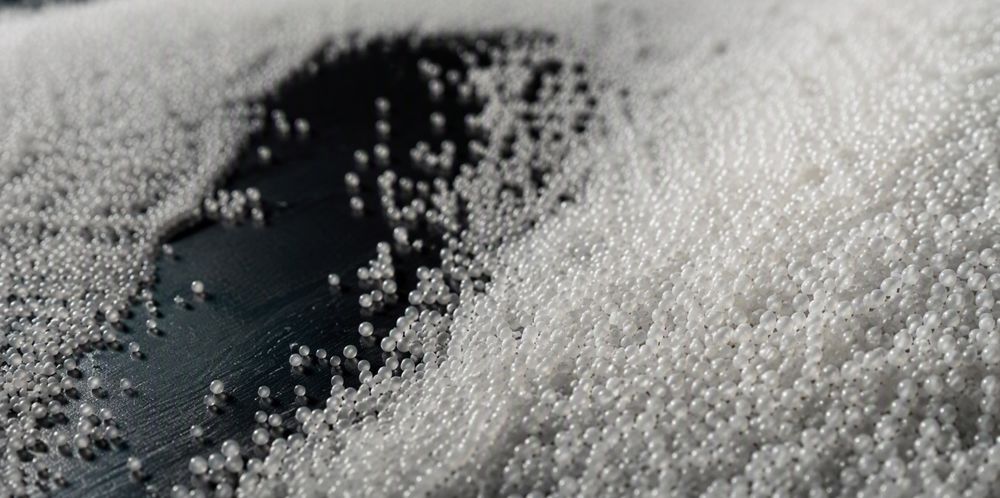 Spherical silica: engineered to flow and pack.
Representative Products at a Glance
The lines below span the three families on this page. Particle size, purity, surface treatment, and packaging are adjustable on all of them.
| Product |
Chemistry / Form |
Typical Specification |
Main Use |
| Quartz Silica Powder |
Crystalline SiO₂ ≥99.5% |
100–1250 mesh |
Fillers, casting, glass |
| Fused Silica Powder |
Amorphous SiO₂ ≥99.9% |
Micron grades, low CTE |
Investment casting, refractories |
| Spherical Silica Filler |
Amorphous, ≥95% sphericity |
D50 0.2–40 µm |
Epoxy molding compounds, CCL |
| Low-Alpha Spherical Silica |
≤0.001 cph/cm² |
Sub-micron–40 µm |
HBM, DDR5, memory packaging |
| Sub-Micron Spherical Silica |
Amorphous 99.99% |
0.1–5 µm |
Underfill, narrow-gap packaging |
| Fumed Silica |
CAS 112945-52-5 |
BET 90–380 m²/g |
Coatings, adhesives, silicones |
| Precipitated Silica |
CAS 112926-00-8 |
BET 150–200 m²/g |
Tire and rubber reinforcement |
| Colloidal Silica Sols |
10–50% solids |
7–100 nm particles |
CMP slurry, casting binder |
| Monodisperse Silica Microspheres |
CV ≤3% |
30 nm–2.5 µm |
Research, spiking, instrument checks |
| Silica Particle Size Standards |
NIST-traceable |
0.5–16 µm suspensions |
DLS, SEM, counter calibration |
A particle-size result is only as good as the standard behind it, and silica has quietly become the preferred core material for that job. Polymer spheres swell in organic solvents, soften with heat, and float too close to water's density for sedimentation instruments; silica spheres tolerate solvents and temperature, resist biological attack, give far better contrast under electron beams, and at 1.98–2.0 g/cm³ carry enough density to calibrate centrifugal and sedimentation analyzers.
Our certified silica size standards span 0.5 to 16 µm as aqueous suspensions — and 30 nm to 2.5 µm in the nanoparticle range — with coefficients of variation at or below 3% and certified mean diameters traceable to NIST and to the European JRC's reference materials. They serve dynamic light scattering, laser diffraction, electron microscopy, particle counters, and the surface-scanning inspection systems of wafer fabs, following the tradition of reference materials like the JRC's ERM-FD100 and ERM-FD304. Every vial ships with its certified diameter, expanded uncertainty, and concentration.
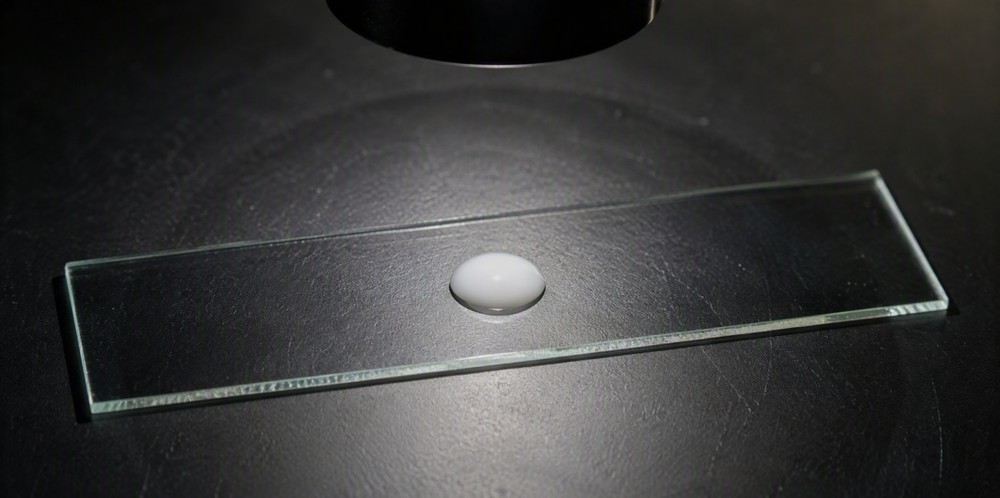 A calibration suspension on the microscope stage.
Quality Control and Documentation
Grades on this page are sold on numbers, so numbers are what we verify. Purity and trace ionics are measured by XRF; size distributions by laser diffraction with D10, D50, and D90 reported; BET surface area on fumed and precipitated grades; sphericity by image analysis on spherical lots; alpha emission by dedicated counting on low-alpha material; and certified diameters by electron microscopy or optical methods on every reference standard. Certificates of analysis accompany each lot, and retained samples stay archived.
How to Specify Silicon Dioxide
- Name the application first: casting shell, EMC filler, tire compound, coating, or calibration bench — the production route follows from it.
- Define the size honestly: D50 and Dmax together; for molding compounds, remember the largest particle must clear roughly one-third of the gate width.
- Set purity and ionics: electronic grades live and die by Na⁺ and Cl⁻ levels, memory grades by alpha counts.
- Ask about surface treatment: silane coupling transforms dispersion and adhesion in resins and rubber — we treat to order.
- For standards, demand the paperwork: certified diameter, expanded uncertainty, and stated traceability, not just a nominal size.
Custom Silicon Dioxide Services
Off-menu work is a large share of what leaves our warehouse: custom distribution cuts with a capped Dmax, silane-treated surfaces matched to your resin chemistry, low-alpha selections screened for a specific memory program, suspensions prepared at your concentration and pH, and reference-material lots characterized for interlaboratory studies. Quantities run from a single vial of standard to pallet loads of filler, documented identically at both ends of the scale.
Tell us the job the silica has to do — we will build the grade, the distribution, and the certificate around it.
For Research or Industrial Raw Materials, Not For Personal Medical Use!