Every particle size analyzer, electron microscope, and liquid particle counter drifts. The question a quality audit eventually asks is always the same: how do you know the instrument is still measuring correctly? The answer is a vial of spheres. Silica reference standards are monodisperse silicon dioxide particles whose diameter has been measured so carefully – and traced so rigorously back to the definition of the meter – that they can serve as the yardstick for everyone else's measurements. Run the standard, compare the reading with the certified value, and you know exactly where your instrument stands.
Silica has earned a permanent place in this role alongside polystyrene, and for applications involving solvents, heat, UV exposure, or simply the need for a particle that behaves like a mineral rather than a plastic, it is the preferred material. Certified silica standards exist across an extraordinary span – from 19-nanometer colloids certified by the European Commission's Joint Research Centre to 100-micrometer microspheres – and Eata Silicon supplies NIST-traceable size standards, zeta potential standards, count standards, and custom reference materials across this full range.
Browse Our Products
 Colloidal silica reference material, sealed and certified.
Why Silica, Not Polymer
- No swelling – polystyrene spheres can swell in organic solvents and shift their apparent diameter; amorphous silica keeps its size in water, alcohols, and most process fluids.
- Higher, well-defined density – around 2.0 g/cm³ for precipitated and colloidal grades, versus roughly 1.05 g/cm³ for polystyrene – which makes silica the better calibrant for sedimentation-based methods such as centrifugal liquid sedimentation.
- Solvent, UV, and heat resistance – silica standards survive cleaning regimes, sterilization, and environments that would degrade polymer beads.
- A realistic mineral analog – for calibrating instruments that measure ceramic powders, pigments, fillers, or abrasives, a silica standard matches the optical and density behavior of the real samples far better than a plastic sphere.
- Biocompatible and non-toxic – suitable for life-science instrumentation, from flow cytometers to nanoparticle tracking systems.
 One drop is enough – dosing a size standard into a cuvette.
Where Silica Standards Go to Work
Each sizing technique has its own measurand, and certified silica materials exist for virtually all of them:
- Dynamic light scattering (DLS) – certified intensity-weighted harmonic mean diameters assigned per ISO 22412 give DLS instruments a direct trueness check; the JRC's ERM-FD100, for instance, carries a certified DLS diameter of 19.0 ± 0.6 nm.
- Centrifugal liquid sedimentation (CLS) – silica's higher density makes it the natural calibrant for disc centrifuges; ERM-FD100 and ERM-FD304 carry certified modal Stokes diameters measured per ISO 13318-1.
- Electron microscopy (TEM/SEM) – monodisperse spheres on a grid verify magnification calibration and validate image-analysis routines; number-based modal diameters are a routine certified quantity.
- Laser diffraction and optical particle counters – micron-range silica microspheres, calibrated by TEM or optical microscopy from 0.5 to 16 µm and beyond, validate both sizing and counting response.
- Zeta potential and electrophoretic mobility – colloidal silica is stable and well-characterized enough to anchor these measurements too; NIST's SRM 1992 certifies a zeta potential of −58 ± 5 mV for colloidal silica in buffer.
- AFM and nanoparticle tracking analysis – silica nanospheres between 20 and 200 nm serve as transfer standards in interlaboratory comparisons across these techniques.
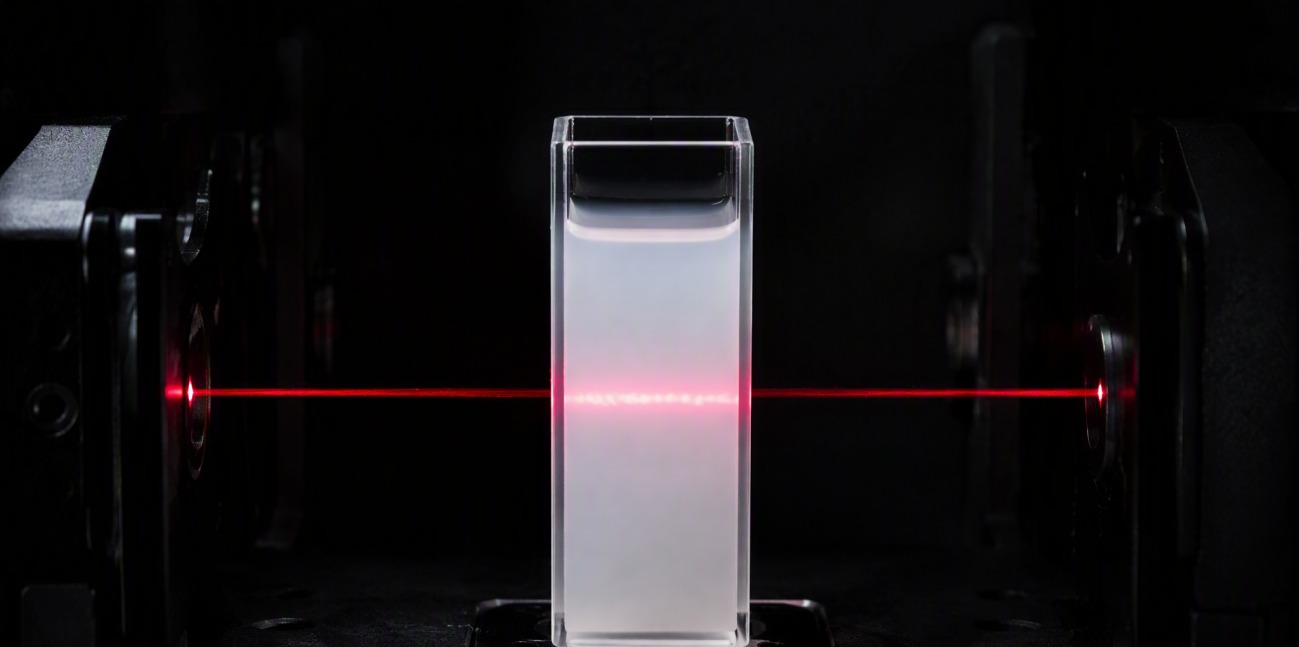 The Tyndall glow inside a dynamic light scattering measurement.
The Traceability Ladder: Landmark Certified Materials
| Material |
Producer |
Certified Quantities |
| ERM-FD100 |
EC Joint Research Centre |
Colloidal silica, ~20 nm: 19.0 ± 0.6 nm (DLS), 20.1 ± 1.3 nm (CLS), 19.4 ± 1.3 nm (EM), 21.8 ± 0.7 nm (SAXS) |
| ERM-FD304 |
EC Joint Research Centre |
Colloidal silica, ~40 nm: 42.1 ± 0.6 nm (DLS), 33.0 ± 3.0 nm (CLS) |
| ERM-FD101b |
EC Joint Research Centre |
Colloidal silica, ~85–90 nm, certified by DLS, CLS, EM, SAXS, and particle tracking |
| ERM-FD102 |
EC Joint Research Centre |
Bimodal silica mixture (~20 nm + ~85 nm) for validating distribution-resolving methods |
| SRM 1992 / SRM 1993 |
NIST (jointly ERM-FD305/306) |
Zeta potential and electrophoretic mobility of colloidal silica: −58 ± 5 mV |
| GBW 12013–12016 |
NIM China |
Silicon dioxide particle size reference materials at 143, 296, 458, and 951 nm |
Commercial NIST-traceable silica size standards build on this foundation: certified products are commonly available from 100 nm to 5 µm with coefficients of variation below 3%, as 0.5–16 µm TEM- or optical-microscopy-calibrated microspheres, and as nanosphere series from 50 nm to 1 µm – most supplied as ready-to-dilute aqueous suspensions in dropper-tipped vials.
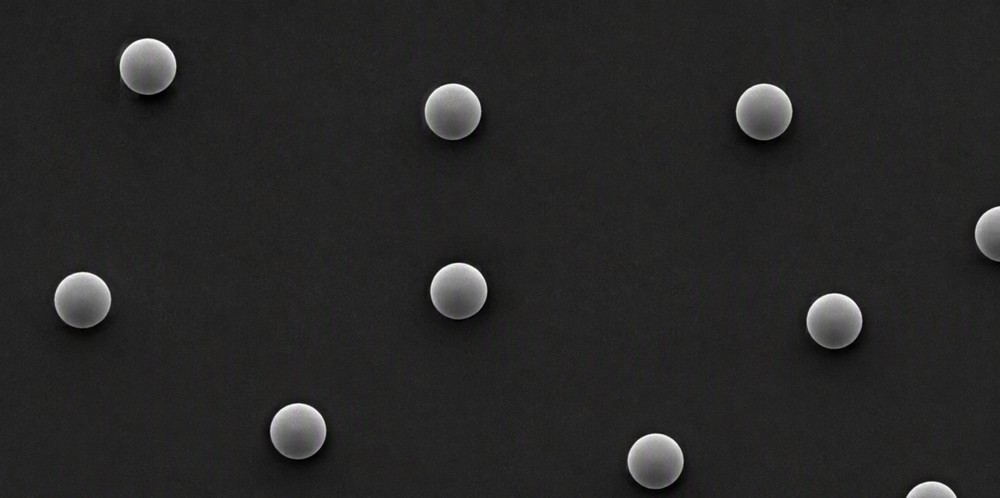 Electron microscopy: the method behind certified diameters.
Representative Products at a Glance
| Product Type |
Typical Specification |
Typical Use |
| NIST-traceable silica size standards |
100 nm – 5 µm, CV < 3%, SI-traceable |
DLS, CLS, and microscope calibration |
| Silica nanosphere standards |
50 – 1000 nm discrete diameters |
Nanoparticle analyzers, NTA, AFM |
| Silica microsphere size standards |
1 – 100 µm, TEM/optical calibrated |
Laser diffraction, particle counters |
| Certified colloidal silica standards |
20–90 nm, multi-method certified values |
Method validation, interlaboratory comparison |
| Zeta potential standards |
Colloidal silica, certified −58 ± 5 mV class |
Electrophoretic light scattering instruments |
| Particle count standards |
Known concentration, 1–2% solids base |
Liquid particle counter validation |
| Bimodal distribution standards |
Mixed ~20 nm + ~85 nm populations |
Resolution testing of sizing methods |
| Calibration standard sets |
3–6 diameters bracketing instrument range |
Multi-point instrument qualification |
| Dry silica reference powders |
Monodisperse spheres, redispersible |
SEM stage calibration, dry dispersion checks |
| Custom-diameter reference materials |
Customer-specified size, CV, and matrix |
Method development, in-house QC materials |
 A dilution series prepared from a single stock standard.
Using a Standard Without Breaking It
A certified value only survives if the material does. A few handling rules protect both:
- Homogenize before sampling – invert or gently roll the vial; never shake hard enough to entrain bubbles or foam, and never vortex fragile suspensions.
- Never freeze aqueous suspensions – ice formation irreversibly aggregates colloidal silica and voids the certified value. Store at room temperature or as the certificate directs.
- Dilute into filtered, clean dispersant – deionized water passed through a 0.2 µm filter is the default; contamination, not the standard, is the usual cause of a failed calibration.
- Do not let drops dry on the vial threads – dried silica forms aggregates that fall back into the stock and seed false oversize counts.
- Respect the uncertainty budget – the certified value applies to the stated measurand and method; a DLS-certified diameter is not interchangeable with a Stokes diameter or a microscopy number.
- Record lot numbers – traceability in your quality system ends at the specific lot on your bench, so log it with every calibration.
 One certified diameter, checked on the microscope stage.
Off-the-shelf diameters cover most benches, but method development and in-house QC often call for something more specific. Eata Silicon prepares custom-diameter silica standards with tightened size distributions, customer-specified concentrations and suspension matrices, multi-diameter calibration kits configured for a particular instrument model, and bulk reference lots for laboratories building their own internal QC materials. Certification-level characterization – TEM, SEM, centrifugal sedimentation, and electrical sensing zone analysis with NIST-traceable reporting – can be arranged for custom lots on request.
Tell us the diameter, certified quantity, and matrix your method needs, and our team will come back with a proposed specification, a sample, and the documentation format your quality system expects.
For Research or Industrial Raw Materials, Not For Personal Medical Use!