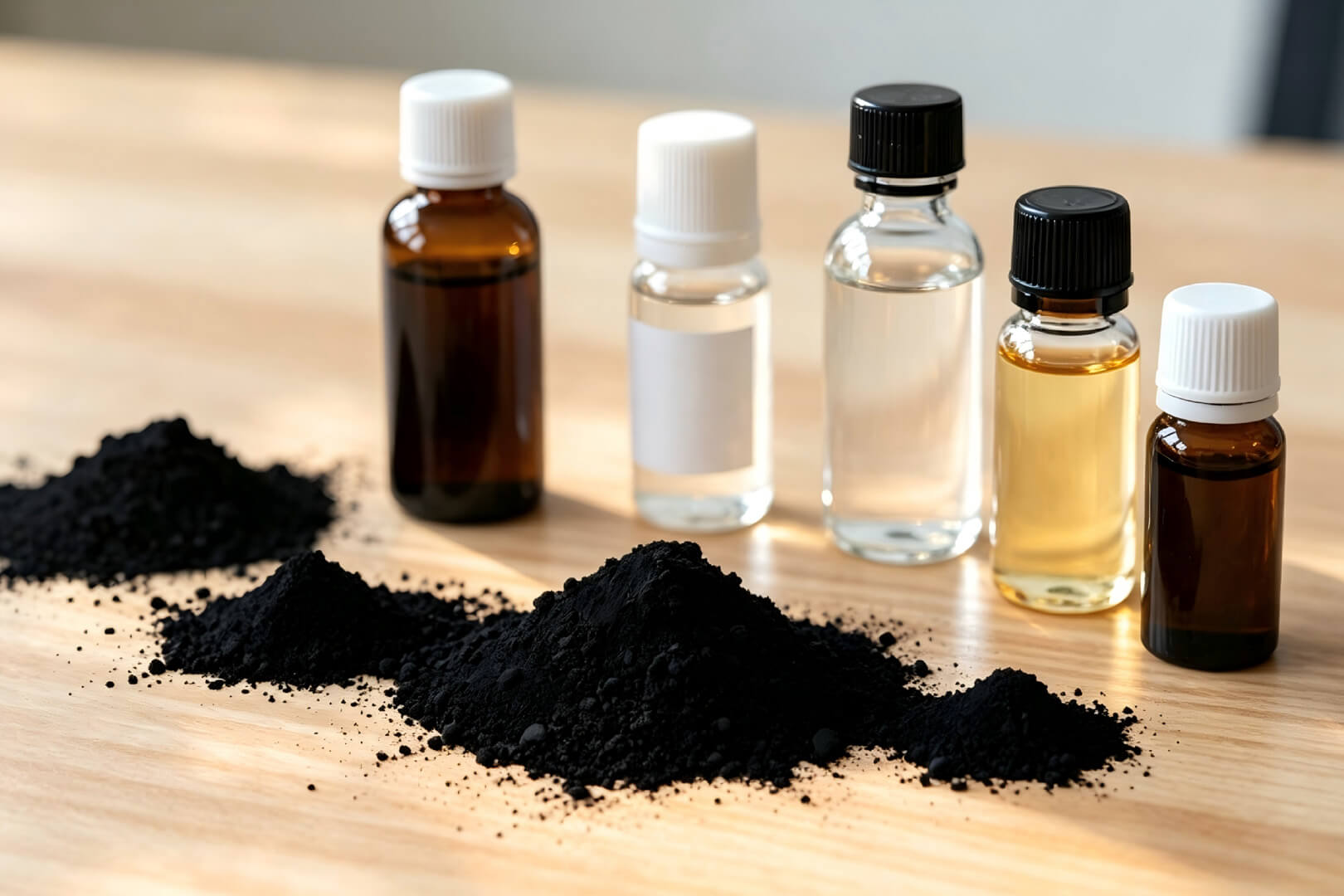
Chlorine gets the headlines in silicon chemistry, but it is only one rung of a ladder. Swap it for fluorine and the silicon-halogen bond becomes the strongest single bond silicon forms – the basis of etching gases and fiber-optic dopants. Swap it for bromine or iodine and the bond becomes the easiest to break – which is exactly what pharmaceutical chemists want when they need to unmask an ester or split an ether under conditions gentle enough to leave the rest of a complex molecule untouched. Choosing the halogen on silicon is not a detail; it is a design decision, and each choice opens a different industry.
This page covers the halosilane monomer family beyond the chlorosilane workhorses (which have their own page): iodosilanes and bromosilanes for selective cleavage and silylation chemistry, silicon tetrafluoride for plasma processes and fluorine doping, and silicon tetrabromide for CVD and nanomaterials. Eata Silicon supplies the full ladder – from gram-scale research ampoules to cylinder gases and bulk drums – with the moisture-tight packaging and analytical documentation these air-sensitive compounds demand.
Browse Our Products
 The violet tinge of iodine: a halosilane ampoule, sealed from air and light.
The Halogen Ladder on Silicon
One set of numbers explains nearly everything about this family – the bond between silicon and its halogen weakens steadily as you descend the group, and reactivity climbs in step:
| Bond |
Strength (approx.) |
Character |
Signature Uses |
| Si–F |
~565 kJ/mol |
Exceptionally strong, stable |
Etching and implant gases, fluorine doping |
| Si–Cl |
~380 kJ/mol |
Reactive but manageable |
Silicone production, silicon deposition |
| Si–Br |
~310 kJ/mol |
Fast, chemoselective |
Phosphonate and ester cleavage, CVD |
| Si–I |
~235 kJ/mol |
The best leaving group |
Ether and ketal cleavage, deprotection |
The ladder also dictates how these monomers are made: heavy halosilanes are rarely synthesized directly – they are exchanged into existence. Iodotrimethylsilane is prepared from trimethylchlorosilane and sodium iodide in acetonitrile, a halogen-exchange (Finkelstein-style) equilibrium that the insolubility of sodium chloride drives to completion. The same logic converts chlorosilanes to their bromo and iodo homologs, and it is why we can supply mixed-halide grades that catalogs rarely list.
Iodosilanes and Bromosilanes: The Cleavage Specialists
Iodotrimethylsilane (TMSI) is a colorless liquid boiling at 106–109 °C – and one of the most useful scalpels in synthesis. Its silicon atom grabs oxygen while its iodide leaves, so it cleaves ethers, esters, ketals, and carbamates under mild, neutral conditions that protect acid-sensitive functionality elsewhere in the molecule. Classic procedures return the free alcohol from a methyl ether in 83–89% yield, and pharmaceutical process groups lean on that selectivity for dealkylation steps deep into multi-step routes.
- Bromotrimethylsilane (TMSBr) – slower and more chemoselective than TMSI, and the reagent of choice for cleaving phosphonate esters: dialkyl phosphonates convert completely in one to three hours, where forcing conditions would degrade the product.
- In-situ TMSI – generated from TMSCl and NaI in acetonitrile, often outperforming the pre-formed reagent on ethers; we supply both the reagent and the matched TMSCl/NaI components.
- Deprotection logic – the stronger the oxygen-silicon attraction and the weaker the silicon-halogen bond, the cleaner the cut; iodide for stubborn ethers, bromide when selectivity matters more than speed.
Because every one of these reactions releases the corresponding hydrogen halide on contact with moisture, dry glassware and inert technique are not optional – which is precisely why packaging discipline (below) matters as much as purity.
 Cleavage chemistry in progress: iodosilane at work in the cooling bath.
Silicon Tetrafluoride: The Gaseous Fluorosilane
At the ladder's top sits a gas. Silicon tetrafluoride (SiF₄, CAS 7783-61-1) – first prepared by Scheele in 1771 – is a colorless, pungent, nonflammable gas that melts at –90 °C and sublimes at –95.7 °C, produced at industrial scale when sulfuric acid attacks fluorspar in the presence of silica, or as the companion of fluorosilicic acid in phosphate processing. Water converts it to silicic acid and HF, and the HF complexes the remaining SiF₄ into fluorosilicic acid – itself a feedstock for aluminum fluoride and water-treatment chemistry. But high-purity SiF₄ earns its keep in drier places:
- Plasma etching – a silicon-bearing etchant gas for oxide and silicon processes in microelectronics.
- Ion implantation – a dopant-gas source of silicon ions for precisely engineered doping profiles.
- Low-k dielectrics – a controlled fluorine source for low-dielectric-constant films that cut capacitive coupling in advanced interconnects.
- Synthesis – a Lewis-acid catalyst and fluorinating agent, and the starting point for fluorosilicic acid manufacture.
Fluorine Doping: Where Fluorosilanes Meet Light
Optical fiber design is a tug-of-war between two dopants: germanium raises silica's refractive index, and fluorine – one of only two index-lowering dopants, alongside boron oxide – pushes it down. That downward push enables the pure-silica-core architecture: leave the core as undoped, intrinsically low-scattering SiO₂, and depress the cladding with fluorine instead. The design avoids the central index “dip” that collapsing germanium-doped preforms can suffer, trims Rayleigh scattering, and – because fluorine relaxes strained Si–O–Si bonds – extends transparency into the deep ultraviolet. In MCVD practice, fluorine arrives from precursors such as SiF₄, C₂F₆, or CCl₂F₂ co-fed with SiCl₄; index depressions around −0.5×10⁻³ at roughly 1.7–1.8 mol% fluorine are routine, and every parameter traces back to the purity of the halosilane feed.
 Fluorine inside the glass: doped fibers carry light for thousands of kilometers.
Representative Products at a Glance
| Product |
CAS No. |
Typical Use |
| Iodotrimethylsilane (TMSI) |
16029-98-4 |
Ether, ester, ketal, and carbamate cleavage |
| Bromotrimethylsilane (TMSBr) |
2857-97-8 |
Phosphonate ester cleavage, selective dealkylation |
| Silicon tetrabromide (SiBr₄) |
7789-66-4 |
CVD silicon films, Si nanocrystals, SiN coatings |
| Silicon tetrafluoride (SiF₄) |
7783-61-1 |
Plasma etching, implant gas, fiber doping |
| TMSCl + NaI in-situ system |
75-77-4 / 7681-82-5 |
Convenient TMSI generation for ether cleavage |
| Dimethyldibromosilane |
Synthesis grade |
Bromofunctional monomer for polymer chemistry |
| Bromo- and iodotrialkylsilane homologs |
Custom |
Tailored reactivity for process chemistry |
| Fluorochlorosilane mixed halides |
Custom |
Research intermediates, specialty deposition |
| High-purity SiBr₄ (trace metals) |
7789-66-4 |
99.995% grades for electronics research |
| Custom halosilane synthesis |
By structure/CAS |
Gram-to-kilogram, documentation included |
Silicon Tetrabromide: CVD's Bromine Route
Silicon tetrabromide (SiBr₄, CAS 7789-66-4) is a dense, fuming liquid – melting at 5 °C, boiling at 153–154 °C, weighing 2.8 g/mL – that turns pale yellow in air and hydrolyzes to HBr and silicic acid on contact with water. Its bromine content makes it an exceptionally clean silicon donor: chemical vapor deposition with SiBr₄ grows silicon thin films for electronics and photonics; reduction with alkali metals yields photoluminescent silicon nanocrystals (with solvent or ionic-liquid stabilization); and pyrolysis followed by ammonia treatment converts it into silicon nitride coatings. Ceramics, sealants, and cutting-tool formulations consume it as a reactive silicon source, and electronics research orders it at 99.995% trace-metals grade – a level our distillation and packaging routinely document.
 High-temperature conversion: halosilanes meet the tube furnace.
Quality Control and Air-Sensitive Logistics
Halosilane quality control runs on three pillars. Assay and identity come from GC with full impurity profiles, backed by halide titration and refractive index; moisture by Karl Fischer, because hydrolysis is the family's universal failure mode; and for the deposition grades, trace metals by ICP-MS against 99.995% baselines. TMSI adds its own quirk: light liberates iodine, so it ships in amber or foil-shielded containers, and any violet tinge in a certificate photograph tells the age of the sample.
Packaging is engineered around that chemistry. Research quantities travel flame-sealed in ampoules or crimp-capped bottles under nitrogen; SiF₄ moves as a liquefied gas in dedicated cylinders; SiBr₄ in nitrogen-blanketed glass or PTFE-lined containers. Recipients should plan Schlenk-line or glovebox handling for the liquids and corrosion-resistant regulators for the gas – and every container carries its measured COA with handling notes.
 Air stays out: halosilanes handled under inert atmosphere.
 Crimp-sealed and partitioned: research quantities packed for shipment.
How to Specify Halosilane Monomers
- Identify the product by name and CAS number – homolog names overlap across four halogens.
- Set assay and the impurity that matters: moisture first, then halide, color, and trace metals for deposition grades.
- Describe the chemistry planned – cleavage, silylation, CVD, doping, or nanocrystal synthesis – so we can flag the contaminants that would interfere.
- Choose the form: ampoule, crimp bottle, drum, or gas cylinder, plus regulator compatibility for SiF₄.
- State light-sensitivity and blanketing needs for iodo compounds, and any custom stabilization.
- Give volumes: evaluation quantity now, projected annual usage – so packaging scales with your program.
Working from a literature procedure? Send the method – we will recommend the grade and the in-situ alternative where it offers cleaner conversion.
Custom Halosilane Synthesis
The exchange chemistry that makes halosilanes also makes them custom-friendly. Eata Silicon regularly prepares bromo- and iodosilane homologs to order – trialkyl and dialkyl variants, mixed-halide monomers, fluorochlorosilane intermediates, high-purity SiBr₄ at trace-metals grade, and in-situ reagent kits matched to a published procedure. Halogen-exchange runs scale from grams to kilograms with full analytical documentation, and unfamiliar structures are welcome: send the CAS number or drawing and our synthesis team will quote it.
Tell us the monomer, the purity you are working toward, and the volumes on your roadmap, and our team will respond with a recommended grade, complete analytical documentation, and samples for your own evaluation.
| Catalog Number |
Product Name |
Order |
Quantity |
|
ORM-0223 |
(3-Bromopropyl)trichlorosilane, CAS 13883-39-1
|
Inquiry
|
|
|
ORM-0224 |
(3-Bromopropoxy)(tert-butyl)dimethylsilane, CAS 89031-84-5
|
Inquiry
|
|
|
ORM-0225 |
tert-Butyl(3-chloropropoxy)dimethylsilane, CAS 89031-82-3
|
Inquiry
|
|
|
ORM-0226 |
3-Chloropropyltrimethylsilane, CAS 2344-83-4
|
Inquiry
|
|
|
ORM-0227 |
3-Bromopropyltrimethoxysilane, CAS 51826-90-5
|
Inquiry
|
|
|
ORM-0228 |
Triethylbromosilane, CAS 1112-48-7
|
Inquiry
|
|
|
ORM-0229 |
11-Bromoundecyltriethoxysilane, CAS 200138-14-3
|
Inquiry
|
|
|
ORM-0230 |
2-Bromoethoxy-tert-butyldimethylsilane, CAS 86864-60-0
|
Inquiry
|
|
|
ORM-0231 |
Chloroisobutyl Pentachlorodisilapropane, 95%, MW 339.02
|
Inquiry
|
|
For Research or Industrial Raw Materials, Not For Personal Medical Use!