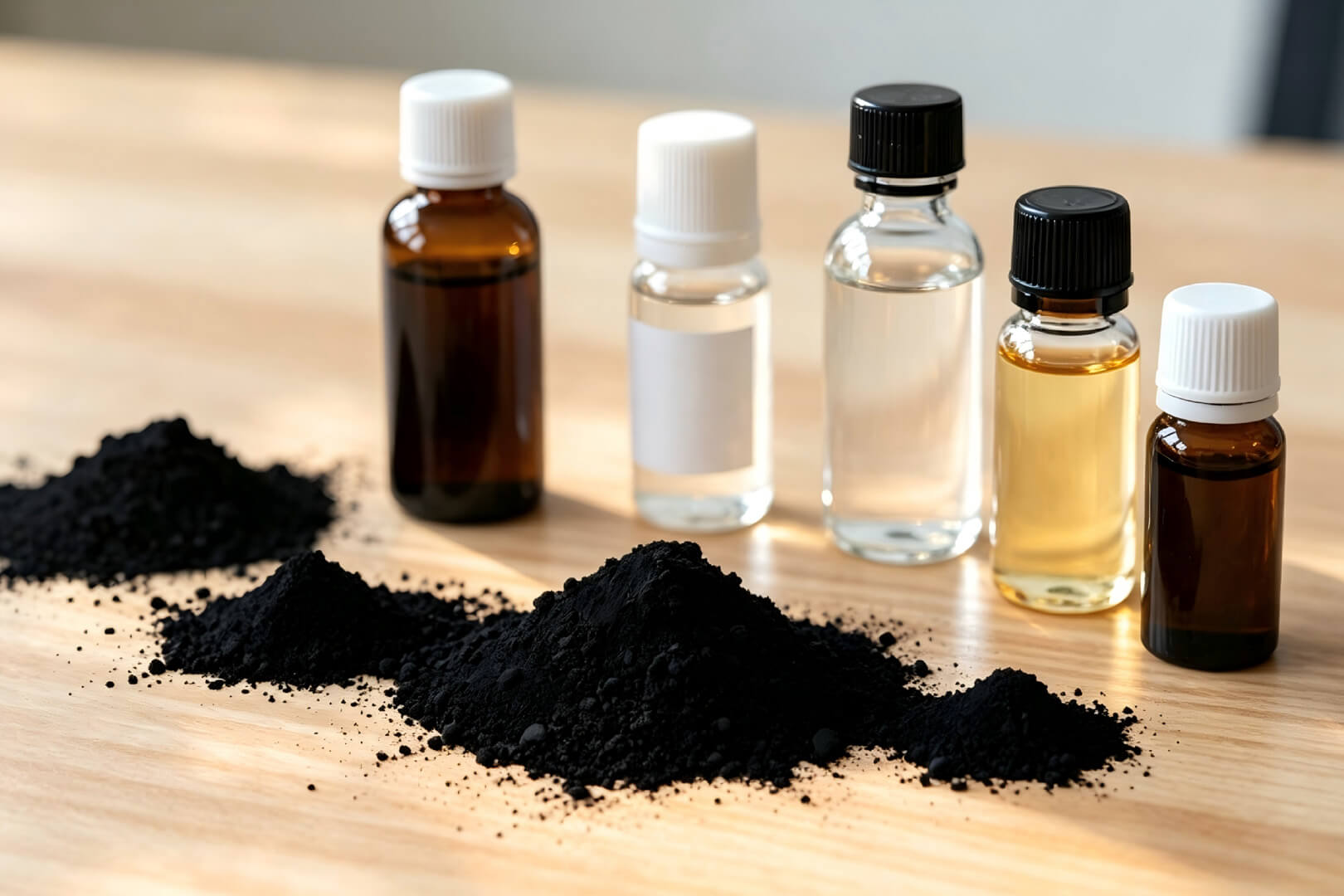
Place oxygen and nitrogen around the same silicon atoms and an interesting compromise emerges. Silicon oxynitride carries the oxidation resistance and chemical calm of silica, yet keeps much of silicon nitride's strength and legendary thermal shock endurance – and it adds a trait neither parent can claim as strongly: molten aluminum and molten silicon simply refuse to wet it. That single behavior has made oxynitride ceramics and oxynitride-bonded refractories fixtures of the aluminum industry, where a lining that the melt ignores is a lining that lasts.
Crystalline silicon oxynitride, Si₂N₂O, is a high-temperature structural and refractory ceramic – and the structural parent of the O′-sialons. Amorphous silicon oxynitride, usually written SiON, is a thin-film material whose refractive index can be dialed anywhere between glass and silicon nitride, making it a workhorse of integrated photonics. Eata Silicon supplies raw materials for both: Si₂N₂O and SiAlON powders, refractory bonding mixes, sputtering targets, and custom formulations between and beyond them.
Browse Our Products
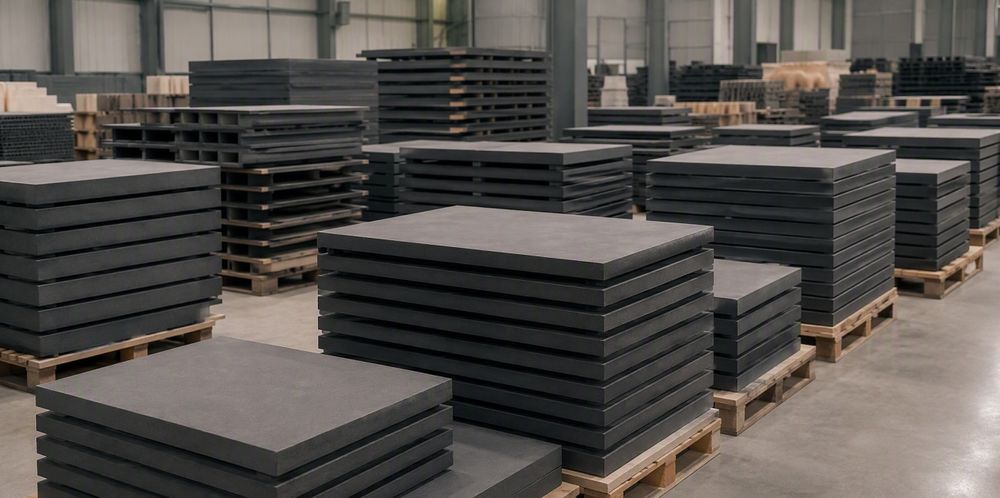 Oxynitride-bonded kiln shelves, stacked and ready for the furnace.
How Silicon Oxynitride Is Made
No ore yields Si₂N₂O; it is always assembled from simpler silicon compounds, and the route sets the purity and price:
- Direct reaction of silica and silicon nitride – the classic route: SiO₂ + Si₃N₄ → 2Si₂N₂O. Thermodynamics permits it from about 1,140 °C, but the rate is stubbornly slow, so production practice adds activators or liquid-forming oxides such as Li₂O, MgO, Al₂O₃, or Y₂O₃ to finish the conversion at practical temperatures.
- Nitridation of silicon–silica mixtures – a blend of Si and SiO₂ fired in nitrogen; gaseous SiO participates in the reaction, and above silicon's melting point the liquid-assisted path actually favors Si₂N₂O formation over Si₃N₄.
- Carbothermal reduction–nitridation – silica and carbon reacted in nitrogen at 1,400–1,450 °C; a few percent of CaO, BaO, SrO, or yttria sharply raises conversion.
- Ammonia nitridation of amorphous silica – produces amorphous silicon oxynitride that can be crystallized later with sintering additives, a useful entry point for high-surface-area powders.
The same nitriding logic, applied in the furnace to a shaped SiC body with the right additions, is what creates Si₂N₂O-bonded and sialon-bonded silicon carbide refractories – reaction-sintered around 1,400 °C and trusted in service above 1,800 °C.
The SiAlON Family Next Door
Swap some silicon for aluminum and some nitrogen for oxygen inside the nitride lattice and silicon oxynitride gains a large family of solid solutions – the SiAlONs. Three forms matter commercially. β′-SiAlON (Si₆₋zAlzOzN₈₋z, z from 0.2 to 4.2) grows elongated, needle-like grains that bridge cracks and deliver toughness; the Al–O bonds it substitutes are about 50% stronger than the bonds in alumina itself. α-SiAlON hosts stabilizing cations – yttrium, calcium, lithium, or rare earths – inside structural channels, giving equiaxed grains, high hardness, and superior high-temperature stability. O′-sialon is iso-structural with Si₂N₂O itself. Sintered sialons typically reach 600–800 MPa in bending, fracture toughness up to 8 MPa·m½, and hardness of 16–18 GPa; combustion-synthesized (SHS) sialon powders even densify 40–70 °C lower than conventional ones – a real cost lever for part makers.
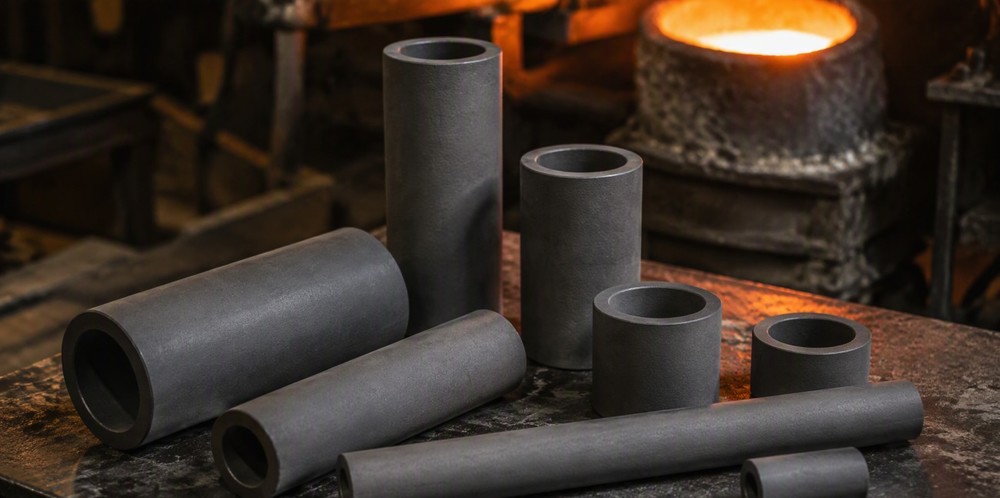 Foundry consumables that molten aluminum refuses to wet.
Where the Crystalline Material Works
- Aluminum-industry refractories – powdered Si₂N₂O is a proven additive for carbon-containing refractories, and dense oxynitride or sialon parts – thermocouple protection sheaths, heater and riser tubes, degassing components – outlive steel and aluminum titanate alternatives many times over in holding furnaces and melt streams.
- Oxynitride- and sialon-bonded SiC kiln furniture – shelves, beams, batts, and bricks that combine SiC's conductivity and load-bearing with a bonding phase that resists oxidation, creep, and metal wetting; firing schedules nitride the bond around 1,100–1,400 °C.
- High-temperature electrical insulators – Si₂N₂O keeps insulating where oxides soften, serving furnace and aerospace electrical hardware.
- Nuclear and dielectric roles – low neutron absorption makes it a candidate reactor moderator, and its low dielectric loss suits radomes and RF-transparent windows that must survive heat.
- Wear and corrosion parts – sialon cutting tools, weld-positioning pins, and components exposed to non-ferrous melts up to about 1,000–1,250 °C, where the material is neither wetted nor corroded by aluminum, brass, or bronze.
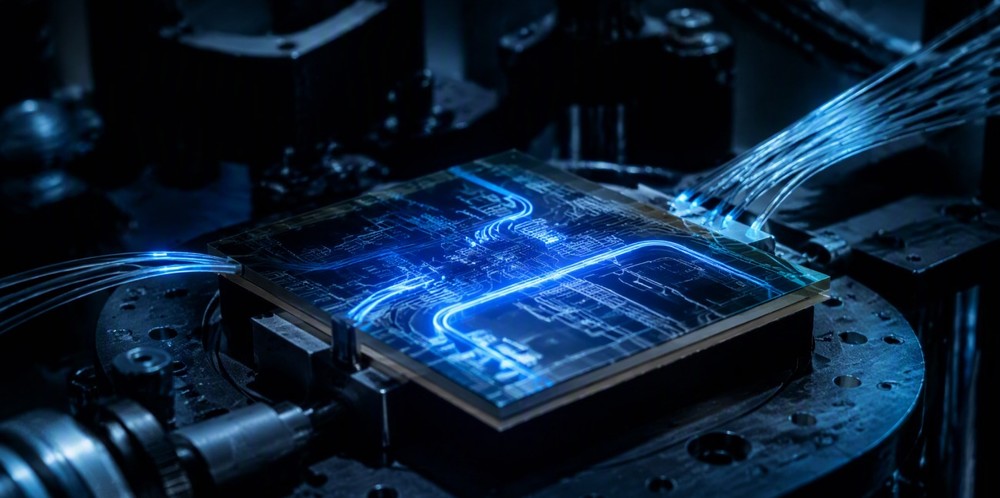 Light guided through SiON: the photonics branch of the family.
The Other SiON: Amorphous Films for Photonics
In a PECVD chamber, silane, ammonia, and nitrous oxide deposit a glassy silicon oxynitride whose refractive index follows the gas recipe – continuously tunable from 1.45 (fused silica) up to about 2.0–2.1 (silicon nitride). That single knob has made SiON a standard platform for photonic integrated circuits: waveguides with propagation losses as low as 0.01–0.6 dB/cm (the best ring resonators reach 0.05–0.2 dB/cm at 1.55 µm), transparency from deep ultraviolet around 210 nm into the infrared, and far lower film stress than pure silicon nitride, so micron-thick cores can be deposited without cracking. The trade-offs are equally well documented – an N–H absorption overtone near 1,510 nm that demands annealing around 1,150 °C, and a modest thermo-optic coefficient – but for telecom components, delay lines, biosensors, and OCT systems, CMOS-compatible SiON remains a default choice. Reactive sputtering from nitride and oxynitride targets offers a hydrogen-free alternative for the same films.
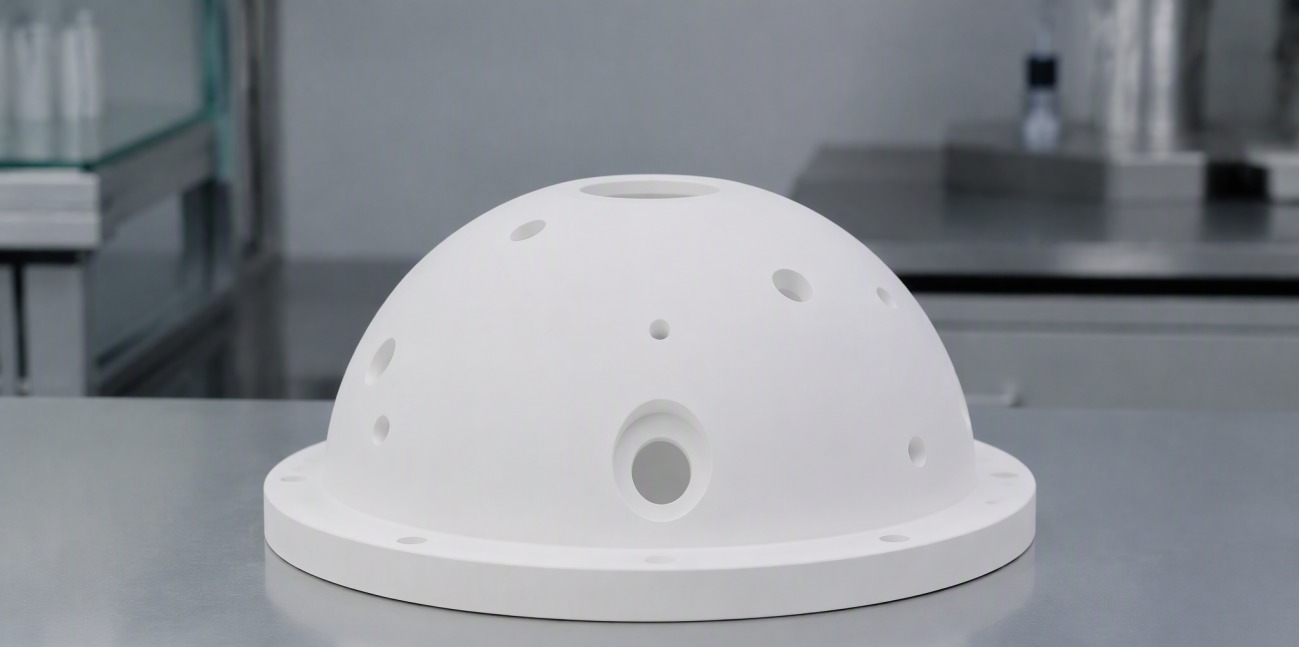 A dielectric ceramic dome built for heat and RF transparency.
Typical Properties at a Glance
Figures below gather representative values for dense Si₂N₂O and sintered SiAlON ceramics; exact numbers shift with composition and processing, and our datasheets quote lot-specific measurements.
| Property |
Typical Value |
| Density |
2.8–2.9 g/cm³ (Si₂N₂O); ~3.2–3.4 g/cm³ (SiAlON) |
| Flexural strength |
600–800 MPa for sintered SiAlON bodies |
| Fracture toughness |
Up to ~8 MPa·m½ via elongated β′ grain reinforcement |
| Hardness |
16–18 GPa (1,430–1,850 HV) depending on phase balance |
| Thermal expansion |
~3 × 10⁻⁶ K⁻¹ – the low CTE behind its thermal shock resistance |
| Thermal conductivity |
15–20 W/m·K |
| Oxidation resistance |
Sound in air to ~1,500 °C, inherited from the oxide side of the lattice |
| Molten-metal behavior |
Non-wetting and non-corroding in aluminum and other non-ferrous melts to ~1,000–1,250 °C |
| Dielectric character |
Low dielectric loss; porous α-SiAlON radome grades reach εr 1.2–3.2 at 12 GHz |
| Optical SiON films |
Refractive index tunable 1.45–2.1; losses down to 0.01 dB/cm class |
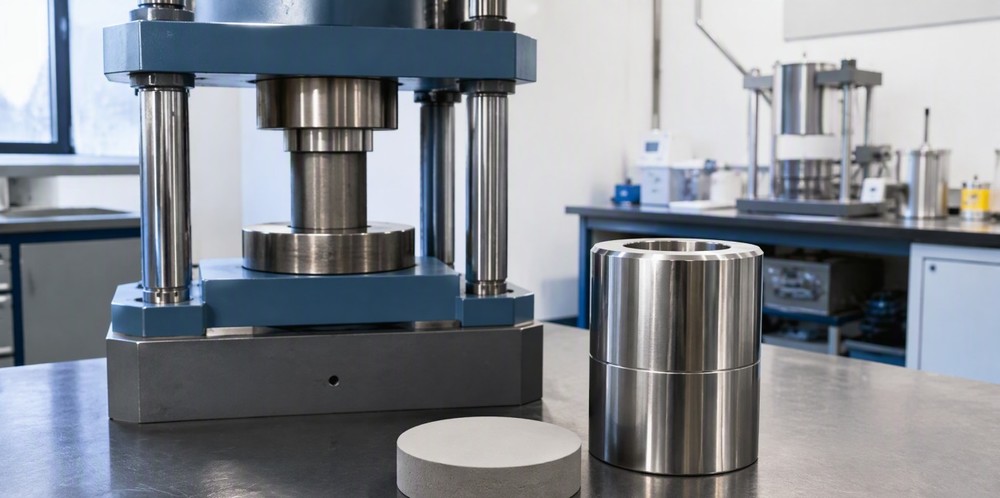 Powder to green body: pressing an oxynitride formulation.
Representative Products at a Glance
| Product Type |
Typical Specification |
Typical Use |
| Silicon oxynitride (Si₂N₂O) powder |
Reaction-synthesized, D50 options 1–20 µm |
Refractory additive, sintering, R&D |
| High-purity Si₂N₂O powder |
Low metals, controlled O/N ratio |
Dielectric ceramics, insulators, radomes |
| Si₂N₂O-bonded SiC forming mix |
SiC grains + Si + additives, nitriding-ready |
Kiln furniture, refractory bricks |
| β′-SiAlON powder |
z-value 0.2–4.2 on request |
Tough sialon parts, cutting tools |
| α-SiAlON powder |
Y / Ca / rare-earth stabilized |
Hard wear parts, high-temperature components |
| α/β mixed-phase SiAlON |
Balanced hardness and toughness |
Tools, wear components, seals |
| SiAlON-forming premix |
Si₃N₄ + AlN + Al₂O₃ + Y₂O₃, pre-blended |
Direct-to-press sialon production |
| SHS SiAlON powder |
Combustion-synthesized, fast-sintering |
Lower-temperature densification, refractories |
| SiON / Si₂N₂O sputtering targets |
Hot-pressed, bonded, RI-designed films |
Optical coatings, photonic circuits |
| Granulated oxynitride mixes |
Spray-dried, binder system on request |
Pressing, isostatic forming |
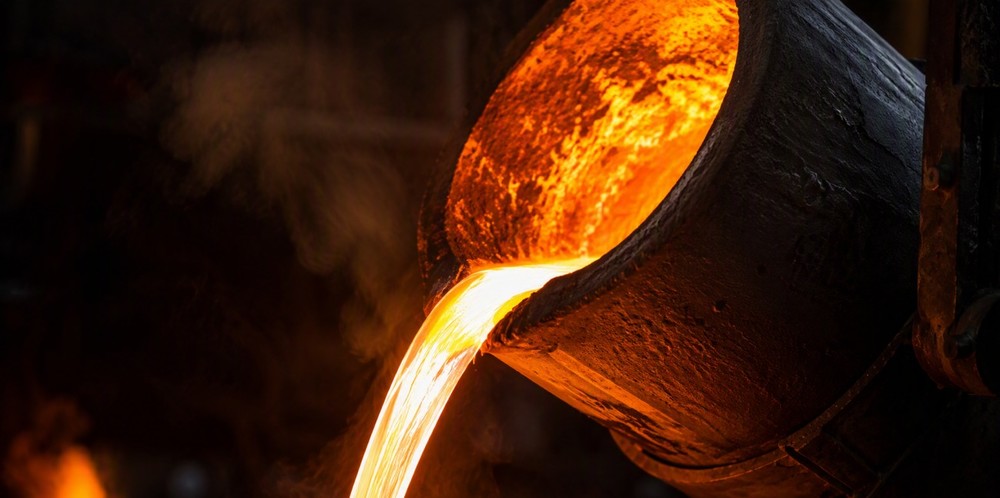 A sialon crucible pours aluminum cleanly – nothing sticks.
Quality Control Across Two Material Families
For crystalline powders, the certificate centers on phase purity: XRD quantifies Si₂N₂O against residual SiO₂ and Si₃N₄, inert-gas fusion fixes the oxygen/nitrogen ratio, and free silicon – the signature of incomplete conversion – is reported separately. Particle size distribution by laser diffraction and BET surface area complete the profile, with metallic impurities by ICP for high-purity grades. Sputtering targets ship with density, grain size, and bonding integrity data, and sialon powders carry their z-value or stabilizing-cation analysis.
Fine oxynitride powders are packed sealed with desiccant – aluminum-lined bags under dry nitrogen for the finest and purest grades – because slow surface hydrolysis changes sintering behavior over time. Targets are vacuum-packed with edge protection. Every shipment carries a lot-specific COA.
Oxynitride work is almost definitionally custom: compositions shift with every furnace and every photonic design. Eata Silicon regularly prepares custom z-value SiAlON powders, Si₂N₂O lots with specified O/N ratios and particle size cuts, pre-blended sialon-forming mixes matched to a customer's sintering cycle, refractory bonding packages tuned to a particular SiC body and nitriding schedule, and sputtering targets engineered for a target refractive index. Pilot quantities for process development are part of the routine.
Describe the composition, form, and service conditions you are aiming at, and our team will come back with a proposed grade, a data sheet, and samples for evaluation.
For Research or Industrial Raw Materials, Not For Personal Medical Use!