A well-designed coating is judged at the surface. Flow marks, craters, orange peel, blocking, drag and premature scuffing can all reduce the value of an otherwise sound formulation. Eata Silicon supplies silicone-based coating and surface-control additives that help formulators manage these interface-level effects in waterborne, solventborne, UV-curable and other industrial material systems.
Our portfolio covers four practical selection routes: silicone-based leveling agents, silicone film-forming agents, silicone waxes and silicone-wax emulsions, and surface-feel / abrasion-resistance additives. Each family approaches the surface from a different direction, allowing buyers to select chemistry around the actual performance gap rather than relying on a single all-purpose additive.
One Surface-Control Portfolio, Four Ways to Tune Performance
Silicone surface additives are valuable because small structural changes can shift how a formulation wets a substrate, flows before cure, migrates or reacts at the interface, and behaves after the film has formed. Silicone polyethers are widely used as low-surface-tension leveling and slip additives; high-molecular-weight silicone dispersions are used when lower friction, abrasion resistance and anti-blocking are the priority; and crosslinkable silicone additives can provide more persistent surface effects after cure.
| Product Category |
What It Helps Control |
| Silicone-Based Leveling Agents |
Improve substrate wetting, flow-out, crater control and surface uniformity; selected grades also add slip, gloss or recoatability. |
| Silicone Film-Forming Agents |
Build a continuous silicone-rich or resin-containing film when water repellency, rub resistance, persistence or a defined film hardness is required. |
| Silicone Waxes and Silicone Wax Emulsions |
Introduce solid or emulsified silicone-wax functionality for film modification, lubrication, release, water resistance and formulation structure. |
| Surface-Feel and Abrasion-Resistance Additives |
Lower surface friction and tune tactile response while targeting mar, scratch, abrasion or blocking resistance in demanding surfaces. |
 Figure 1. Controlled specular reflection across uniformly leveled coating surfaces.
Silicone-Based Leveling Agents
Leveling additives are used when a coating must spread more evenly before the film locks into place. Silicone-containing surface additives can reduce surface tension, improve substrate wetting and help suppress defects such as cratering, cissing and orange peel. Some products also contribute slip, gloss or easier recoating, but those secondary effects depend on molecular structure, compatibility and dose.
Representative Eata Silicon Product Directions
| Product Direction |
Chemistry |
Typical Form / Data |
Performance Focus |
Application Direction |
| Silicone Leveling Additive Family |
Polyether-modified, aralkyl-modified and related siloxane profiles |
Multiple physical forms depending on grade |
Leveling, wetting, slip, anti-blocking, anti-cratering; selected profiles add scratch resistance or high-temperature performance |
Waterborne, solventborne and UV coatings |
| Polyether-Modified PDMS Rapid Leveling Agent |
Polyether-modified PDMS |
Amber transparent liquid; 30-300 cP at 25°C |
Fast leveling, low surface tension, substrate wetting, gloss and recoatability |
UV film coatings, UV metal/plastic coatings, waterborne coatings and inks, varnishes |
| Polyether-Modified Silicone Rapid Leveling Agent |
Polyether-copolymer-modified polysiloxane |
Yellow transparent to translucent liquid; 100-500 cP; >=94% solids |
Crater/orange-peel prevention, wetting and flow-out across waterborne, solventborne and UV systems |
Varnishes, baking coatings, PU systems, leather coatings, waterborne coatings and inks |
For formulation work, select a leveling additive against the binder and cure route first, then validate wetting, gloss, surface defects, recoatability and intercoat adhesion at the intended addition level. A stronger reduction in surface tension is not automatically better if it creates incompatibility elsewhere in the system.
Silicone Film-Forming Agents
Film-forming silicone resins create a continuous phase after application and carrier removal. Trimethylsiloxysilicate, often described as an MQ-type silicone resin, is a well-established film-forming chemistry. Commercial film-former portfolios show that resin content, carrier and molecular design can be adjusted to produce softer, medium or harder films, while silicone-acrylate architectures provide a different balance of flexibility, adhesion and abrasion resistance.
Representative Eata Silicon direction: Trimethylsiloxysilicate film-former powder and resin solutions. The current product data includes a white powder profile and transparent solution profiles with 50-70% resin content. Solution viscosities span 80-120, 180-320, 400-800 and 20,000-30,000 mPa·s at 25°C, depending on profile. Final suitability should be matched to the selected carrier, binder and film-performance target.
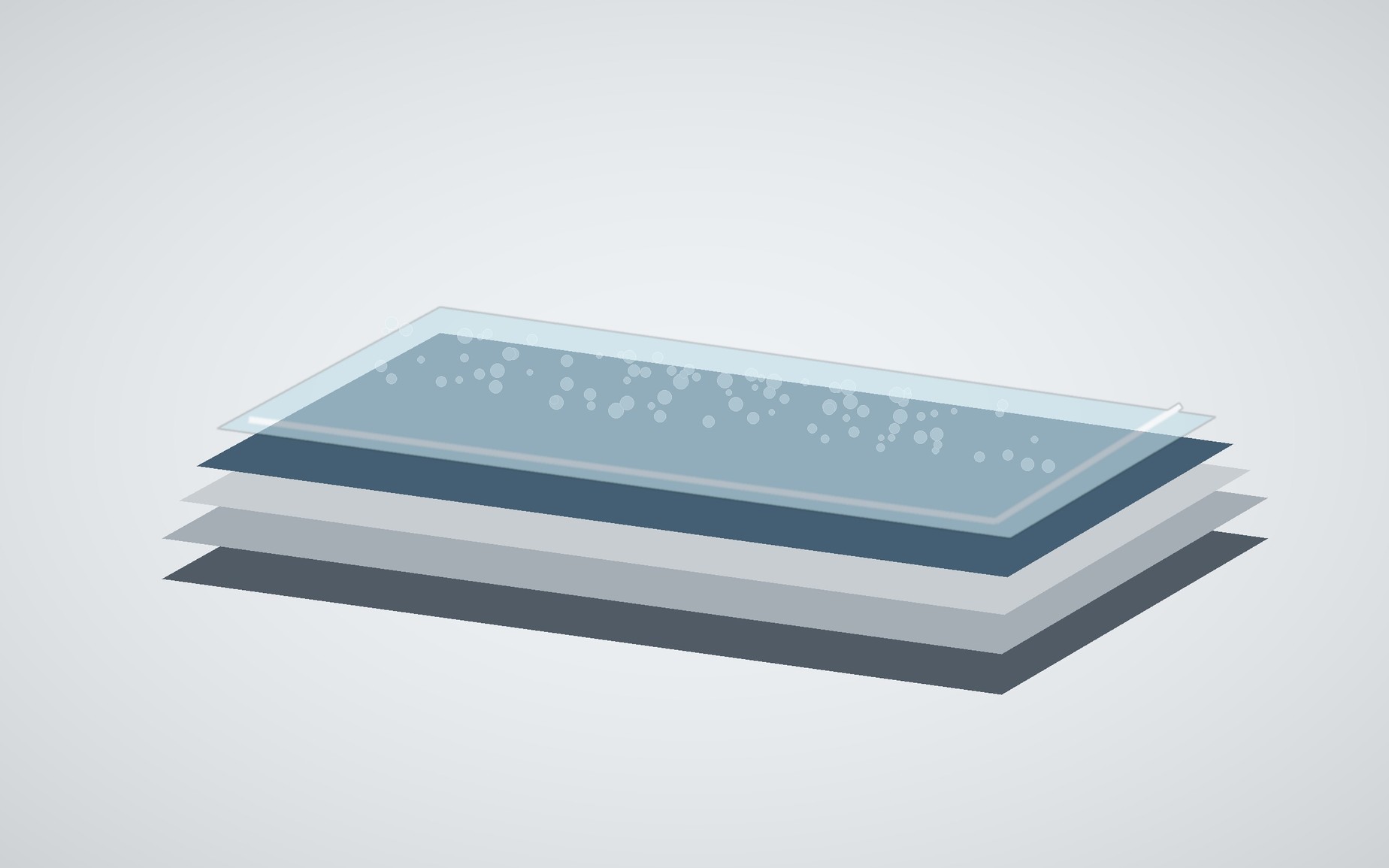 Figure 2. Layered coating architecture with a continuous functional surface film over a metallic substrate.
When Film-Former Chemistry Is Worth Evaluating
- When a surface needs a more persistent silicone-rich film instead of a purely migratory slip effect.
- When wash, rub, water or transfer resistance is part of the performance brief.
- When the formulator needs to balance film hardness with flexibility and carrier compatibility.
- When silicone-resin compatibility with organic oils, silicone fluids or a specific binder must be tuned deliberately.
Silicone Waxes and Silicone Wax Emulsions
Silicone waxes occupy a useful middle ground between a free-flowing silicone fluid and a rigid resin. Long-chain alkyl or resin-modified structures can raise melting point, change compatibility and introduce a solid or semi-solid surface-control function. Emulsion forms offer another route when the formulation is predominantly aqueous or when direct handling of a solid wax is inconvenient.
Representative Product Directions
- C26 alkyl-modified silicone wax, listed with a 45°C melting point: a long-chain silicone wax direction for film-forming protection, slip, internal lubrication and water resistance in industrial material systems.
- Industrial silicone wax emulsion: an emulsified silicone-wax form for formulated industrial systems where a pre-dispersed wax route is preferred.
- Silicone resin wax benchmark chemistries: commercial products in the market show that higher-melting silicone resin waxes can combine wax-like structure with film-forming and durability effects.
 Figure 3. Solid wax domains and dispersed emulsion phases illustrating two silicone-wax delivery forms.
Silicone Wax Selection Questions
- Is the formulation waterborne, solventborne or predominantly oil/resin based?
- Does the wax need to melt during processing, remain as a dispersed phase, or migrate toward the surface?
- Is the priority slip, lubrication, release, water resistance, film modification or rheology?
- What melting range, particle/emulsion stability and compatibility window can the process tolerate?
Surface-Feel and Abrasion-Resistance Additives
A coating can look excellent and still fail when it is touched, stacked, rubbed or repeatedly handled. Surface-feel and abrasion-resistance additives are used to tune the frictional behavior of the cured film. In many silicone systems, lower coefficient of friction contributes to better slip and can reduce the force that produces mar or scratch damage. High-molecular-weight silicone dispersions and crosslinkable silicone modifiers are especially useful when the effect needs to persist beyond initial application.
Representative Eata Silicon Product Directions
| Product Direction |
Chemistry / Key Data |
Performance Focus |
Application Direction |
| Hydroxyl-Functional Polyether-Modified Silicone Slip Additive |
Hydroxyl-functional polyether-modified organosilicone copolymer |
Slip, abrasion resistance, tactile feel and leveling |
High-viscosity inks; PU synthetic leather |
| Silicone Slip Additive for Coating Surface Modification |
Silicone surface additive |
Higher surface slip and smoothness |
Coating formulations requiring increased slip |
| Bifunctional Crosslinkable Silicone Surface-Feel Additive |
Crosslinkable organo-modified PDMS; 1,000-5,000 cP at 25°C |
Durable soft surface feel, anti-blocking, release and gloss support |
Waterborne and solventborne PU/baking coating systems |
| High-Solids Waterborne Abrasion-Resistance Dispersion |
Modified silicone-oil dispersion; 78.0 +/- 3.0% solids |
Smooth surface feel, abrasion resistance, compatibility and dilution stability |
Waterborne coatings, printing inks and surface treatments |
 Figure 4. Wear-track concept for evaluating friction, mar and abrasion behavior on a coated test surface.
Where These Additives Fit in Energy and Industrial Materials
Coating and surface-control additives sit upstream of the final part. Their role is to make a resin, ink, coating, release layer or treated surface behave more predictably during application and use. For energy-material and advanced-industrial programs, relevant formulation work can include protective coatings on metal and polymer components, roll-to-roll film coating, printed functional layers, release and anti-blocking surfaces, coated electrical hardware and other resin systems where surface uniformity and wear behavior affect manufacturing quality.
Because the additive is only one part of the formulation, Eata Silicon recommends qualification in the complete system. Binder chemistry, pigment and filler loading, solvent package, cure conditions, substrate energy and downstream processing can all change the final result.
 Figure 5. Uniform protective finishes across copper and aluminum surfaces used in advanced industrial material systems.
Custom Coating and Surface-Control Additives
A standard grade does not always match the required balance of wetting, surface tension, recoatability, gloss, friction and durability. Eata Silicon can discuss customized coating and surface-control materials around the chemistry and performance window of the project. Customization may focus on silicone-polyether architecture, functional-group design, viscosity, solids or active content, carrier system, emulsion format, crosslinkable functionality, wax structure, compatibility targets and other application-specific specifications.
For a focused evaluation, send us the resin system, substrate, cure route, current additive or benchmark, the surface issue you need to solve, the test values that matter, and any critical formulation constraints. We can review a standard product direction, a close functional alternative or a custom specification for your development program.
For Research or Industrial Raw Materials, Not For Personal Medical Use!