Silicates built the planet – they are the most widespread mineral class in Earth's crust – and for nearly four centuries they have quietly built industry too. Around 1640, van Helmont noted that melting sand with excess alkali produced a curious soluble substance; that substance, water glass, now holds together corrugated cardboard boxes by the billions, boosts laundry detergents, seals engine gaskets, binds foundry molds, and densifies concrete floors. Few chemicals so cheap do so many different jobs, and almost none do them without being noticed.
The silicate family extends well beyond water glass. Swap sodium for potassium or lithium and the binder gains weatherproof mineral-paint credentials or deep-penetrating concrete chemistry. Crystallize the aluminosilicate framework and you get zeolites – molecular sieves that sort gases by the angstrom. Mill zircon sand and you have the opacifier behind white ceramic glazes; hydrate lime with silica and you have insulation boards rated to 1,000 °C. Eata Silicon supplies silicate raw materials across this whole range – liquids, solids, powders, beads, and boards – with custom ratios and sizes available on request.
Browse Our Products
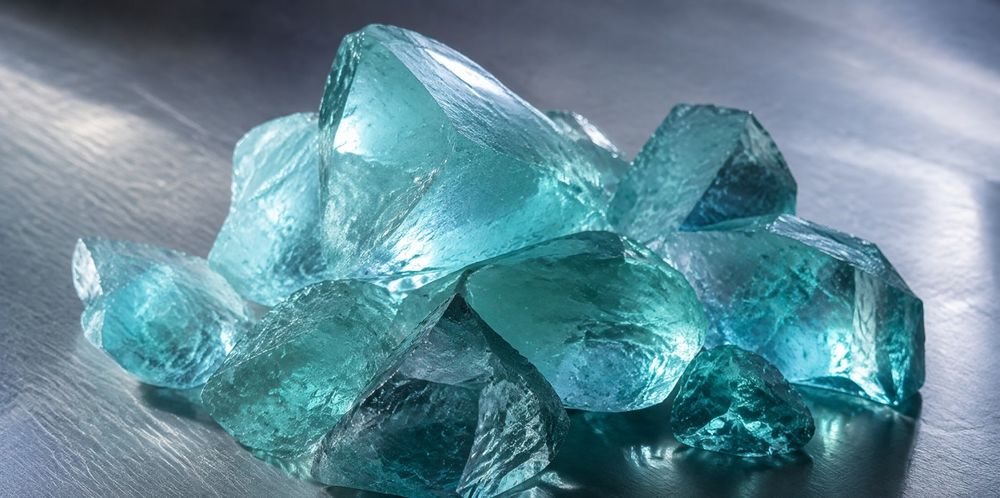 Solid water glass: sand and soda ash, fused above 1,100 °C.
Reading the Modulus: Sodium Silicate's Master Dial
Sodium silicate is made two ways: fusing quartz sand with soda ash above 1,100 °C in a glass furnace – n SiO₂ + Na₂CO₃ → n(SiO₂)·Na₂O + CO₂ – and either belt-cooling the melt into solid cullet or dissolving it into solution; or reacting sand with caustic soda hydrothermally to make solution directly. Either way, one number defines the product: the modulus, the SiO₂:Na₂O ratio (molar ratios run 0.5–4.0 in commerce; grades below ~2.85 are called alkaline, above it neutral). Turn that dial and the chemistry changes jobs:
| Ratio Range |
Behavior |
Where It Goes |
| Below ~2.5 (alkaline) |
High pH (13+), slow setting, strong buffering |
Detergents, cleaners, textile scouring, peroxide bleaching |
| Around 2.0 |
Balanced reactivity |
Zeolite and silica-catalyst feedstock |
| 2.5–3.8 (neutral) |
Fast gelation, rigid glassy bonds, heat resistance to ~1,100 °C |
Cardboard and paper adhesives, foundry binders, refractory cements |
| ~2.84, 43% solids |
Rigid bond as water evaporates |
Engine gasket and metal sealants (pH ≈ 13.4 − 0.69m) |
| Above ~2.5 |
Silica-rich |
Precipitated silica, silica sols and gels |
The most common commercial modulus is 3.3 – the general-purpose binder ratio – but the right answer always follows the application, and we supply the full dial.
 The same glass, dissolved – water glass solution by the drum or tanker.
The Alkali Choice: Sodium, Potassium, or Lithium
- Sodium silicate – the economical workhorse: adhesives, detergents, water treatment, foundry, drilling fluids, fireproofing. When cost rules and versatility counts, this is the default.
- Potassium silicate – the coatings specialist. Mineral paints bound with it shrug off UV (the binder is inorganic), stay vapor-permeable so walls can breathe, and hold up to about 1,500 °C; it is also the classic binder and flux in welding electrodes – potassium for soft and low-alloy steels, potassium–lithium for high-alloy grades.
- Lithium silicate – the small-ion specialist. Lithium's tiny radius lets it penetrate 5–8 mm into concrete capillaries (potassium manages 2–4 mm), where it converts free lime into insoluble calcium silicate hydrate: denser, harder, dust-free floors with the least efflorescence of the family (Li < K < Na). Dried lithium silicate films are the least soluble, decompose only above ~1,600 °C, dry in about 6 hours rather than a day, and make the best-performing waterborne inorganic zinc-rich primers.
- Hybrids – lithium added to sodium or potassium silicate improves adhesion and refractoriness; mixed-silicate liquids are standard practice in welding and premium floor treatments.
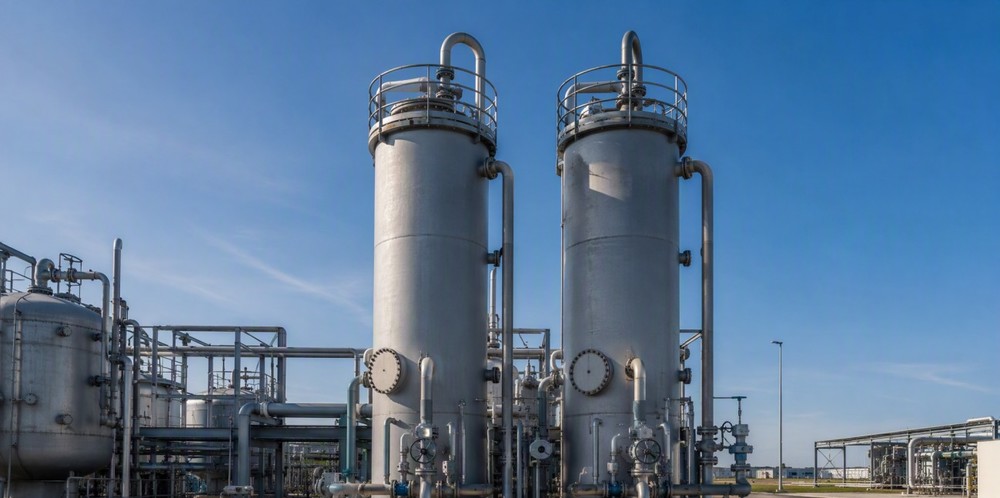 Inside those towers: molecular sieves doing molecular sorting.
Zeolites: Silicates with a Pore-Size Certificate
React sodium silicate with sodium aluminate under the right hydrothermal conditions and the silicate crystallizes into a zeolite – an aluminosilicate framework riddled with pores of one exact diameter. Zeolite 4A (Na₂O·Al₂O₃·2SiO₂·4.5H₂O) is the workhorse: its 4-angstrom windows admit water, CO₂, H₂S, and ammonia while locking out larger molecules, and its sodium ions exchange for calcium and magnesium, which is why powdered 4A replaced phosphates as the builder in eco-friendly detergents (calcium exchange capacity above 300 mg CaCO₃/g). Ion-exchange the sodium for potassium and the window narrows to 3 Å; exchange for calcium and it widens to 5 Å; switch the framework to faujasite and you reach 10 Å. The result is a catalog of precision:
| Type |
Pore Size |
Adsorbs |
Signature Applications |
| 3A |
~3 Å |
Water only |
Ethanol and cracked-gas drying – no co-adsorption of organics |
| 4A |
~4 Å |
H₂O, CO₂, H₂S, NH₃, small gases |
General gas/liquid drying, natural gas, insulating glass, detergent builder |
| 5A |
~5 Å |
Adds n-paraffins (C₃–C₆) |
Normal/isoparaffin separation, PSA H₂ and O₂, sweetening |
| 13X |
~10 Å |
Larger organics, CO₂, VOCs |
Air pre-purification before cryogenic distillation; 13X HP for PSA oxygen |
Static water capacity runs to 21–23 wt%, beads regenerate thermally for years of service, and global demand – about US$3.8 billion in 2025 – keeps growing with air-separation, natural-gas, and phosphate-free detergent capacity.
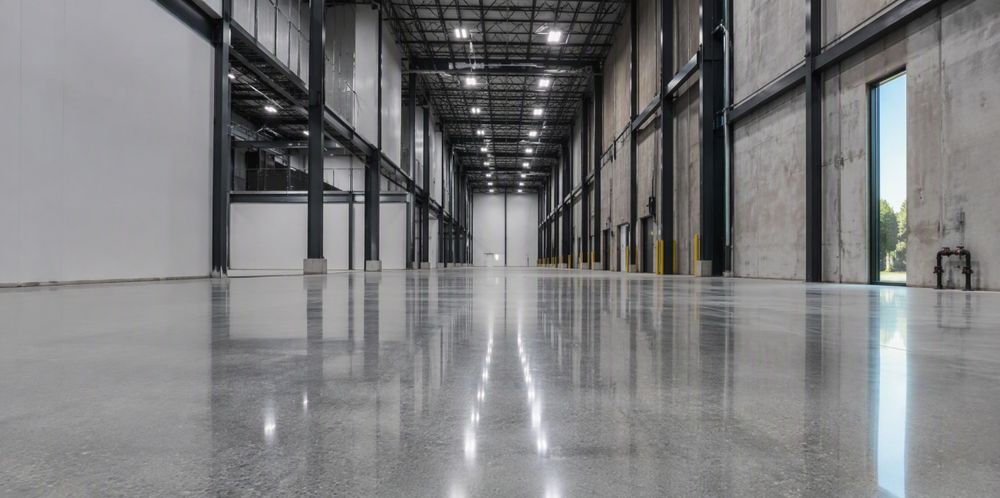 A silicate-densified floor: new C-S-H grown inside the concrete itself.
Mineral and Engineered Silicates
- Zirconium silicate (zircon, ZrSiO₄) – nature's high-refractive-index opacifier: 7.5 Mohs hardness, refractive index 1.93–2.01, insoluble in water, acids, alkalis, and even aqua regia. Milled to around 5 µm it scatters light so efficiently that it has displaced much costlier tin oxide in ceramic glazes; the same chemical inertness and heat stability make it a premier foundry mold and facing material that molten metal will not wet or react with. Australia and South Africa supply most of the million-plus tonnes mined annually.
- Calcium silicate – the insulation board of the process industries: hydrated from lime and silica into lightweight (230–270 kg/m³), non-asbestos boards that hold strength and shape to 1,000 °C with thermal conductivity from about 0.065 W/m·K, serving furnaces, piping, and equipment in petrochemical, glass, metals, and power plants.
- Sodium metasilicate – the crystalline alkaline grade (pentahydrate and anhydrous) whose buffering, water-softening, and fat-hydrolyzing power makes it a mainstay detergent and cleaner ingredient in its own right.
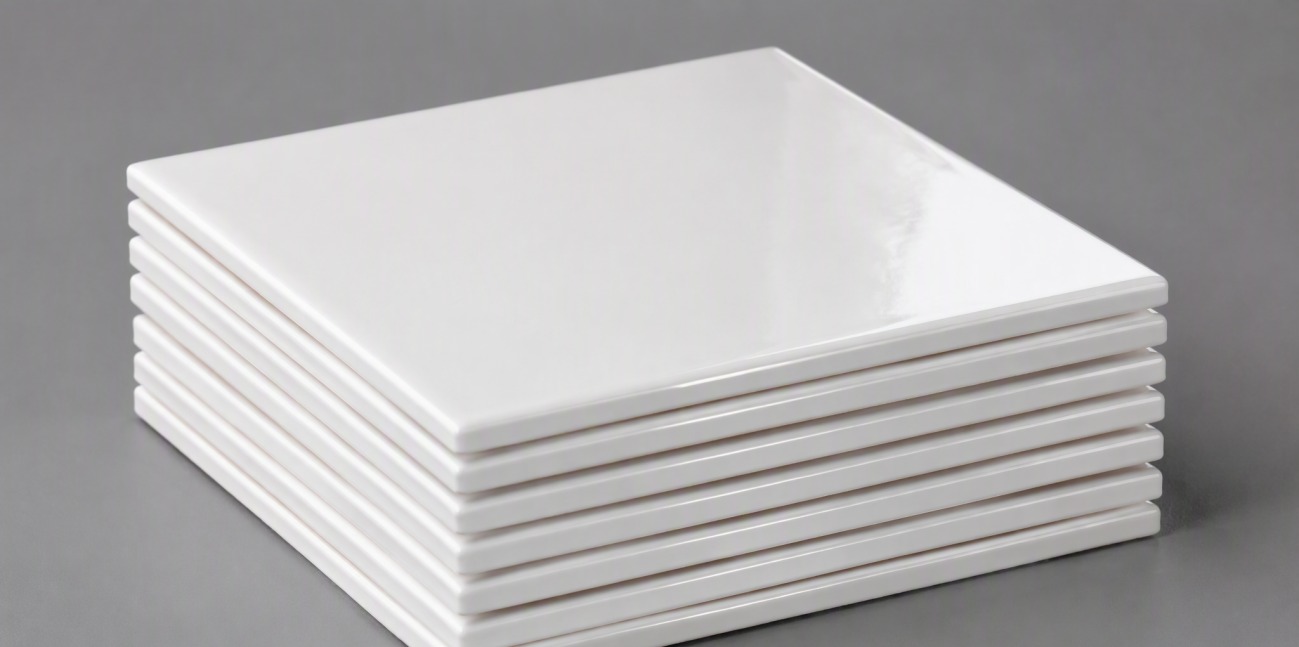 Zircon-opacified glazes – whiteness without tin oxide.
Representative Products at a Glance
| Product Type |
Typical Specification |
Typical Use |
| Sodium silicate solution |
Modulus 1.6–3.75, drums/IBC/ISO tanks |
Adhesives, detergents, binders, treatment |
| Sodium silicate solid (cullet) |
Glassy lumps, low freight cost |
Dissolution on site, export logistics |
| Sodium metasilicate |
Pentahydrate / anhydrous, crystalline |
Detergents, cleaners, metal degreasing |
| Potassium silicate solution |
Coating and welding grades |
Mineral paints, welding electrodes |
| Lithium silicate solution |
High-ratio, low-viscosity, low-Cl grades |
Concrete densifiers, zinc-rich primers |
| Mixed silicate solutions |
Na/K/Li blends to formulation |
Welding fluxes, specialty binders |
| Zeolite 4A powder |
Micronized, Ca exchange > 300 mg CaCO₃/g |
Phosphate-free detergent builder |
| Molecular sieve beads |
3A / 4A / 5A / 13X, 4×8 and 8×12 mesh |
Gas drying, PSA, air pre-purification |
| Zirconium silicate flour |
~5 µm milled, high whiteness |
Glaze opacifier, foundry facing, refractories |
| Calcium silicate insulation |
Boards and shapes, 230–270 kg/m³ |
Furnace and equipment insulation to 1,000 °C |
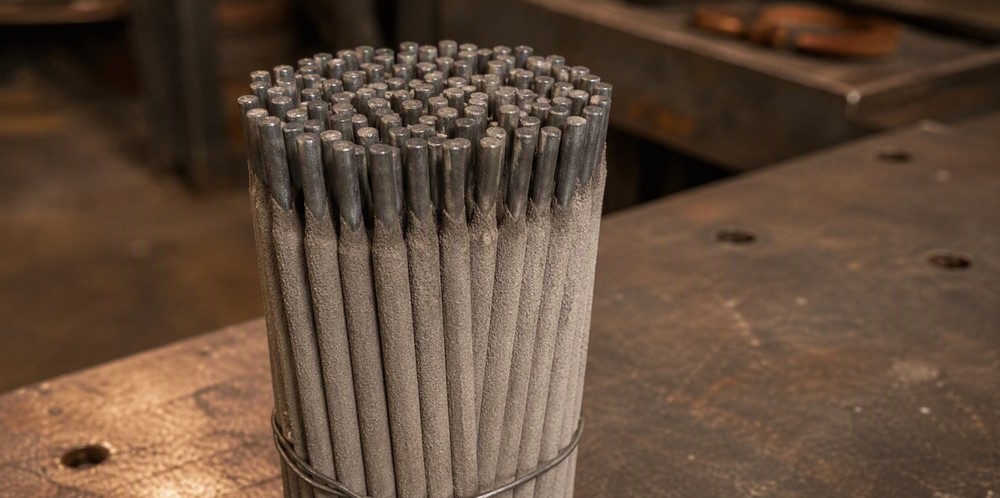 Silicate-bound flux coatings: welding's quiet chemistry.
Quality Control Across Forms
For soluble silicates the certificate centers on the modulus itself: titrated SiO₂ and alkali oxide content, plus solids, density, and viscosity for solutions and clarity after filtration. Molecular sieves carry XRD phase confirmation, static water capacity, crush strength and attrition, bulk density, and package moisture; detergent-grade 4A adds calcium exchange capacity and whiteness. Zircon flours are certified on particle size distribution and whiteness, and insulation boards on density, conductivity, and linear change at temperature.
Solutions ship in drums, IBCs, or ISO tanks; solids and powders in lined bags; molecular sieves in airtight drums with inner foil liners – they begin adsorbing ambient moisture the moment a seal breaks, so keep containers closed until the bed is loaded. Every lot travels with its measured COA.
How to Specify Silicate Materials
- The application first – adhesive, detergent, coating, concrete treatment, drying, opacifier, or insulation; each points to a different silicate and grade family.
- For soluble silicates: cation (Na, K, Li, or blend), modulus or weight ratio, solids content, and viscosity window.
- For zeolites: type (3A/4A/5A/13X), form (powder or bead size), water capacity, and crush-strength requirements.
- For mineral silicates: particle size or D50, whiteness, and any chemistry limits.
- Form and volume: solution versus solid (freight often decides), trial quantity, and annual usage.
Silicate work is ratio work, and catalogs rarely hit every target. Eata Silicon regularly supplies custom modulus solutions tuned to a formulation, mixed Na/K/Li silicate blends for welding and coating systems, low-chloride lithium grades for zinc-rich primers, zeolite powders and beads at specified exchange capacities and size cuts, zircon flours at customer-specified fineness, and insulation boards cut to drawing. Development quantities for process trials are routine.
Share the application, the ratio or pore size you need, and the form that suits your logistics, and our team will respond with a recommended grade, a data sheet, and samples for evaluation.
For Research or Industrial Raw Materials, Not For Personal Medical Use!